


Gin. Part 2
Description
This section is from the book "Drinks Of The World", by James Mew. Also available from Amazon: Drinks of the world,.
Gin. Part 2
On Feb. 20, 1736, in the ninth year of George II., a petition of the Justices of the Peace for Middlesex against the excessive use of spirituous liquors was presented to the House of Commons, setting forth-that the drinking of Geneva and other distilled spirit: uous liquors had greatly increased, especially among the people of inferior rank, that the constant and excessive use thereof had destroyed thousands of his Majesty's subjects, debauching their morals, etc., that the "pernicious liquor" was then sold not only by the distillers and Geneva shops, but many other persons of inferior trades, "by which means journeymen, apprentices and servants were drawn in to taste, and by degrees to like, approve, and immoderately to drink thereof," and that the petitioners therefore prayed that the House would take the premises into their serious consideration, etc. The House having resolved itself into a committee on Feb. 23, Sir Joseph Jekyll moved the following resolutions: (1) That the low price of spirituous liquors is the principal inducement to the excessive and pernicious use thereof. (2) That a discouragement should be given to their use by a duty. (3) That the vending, etc., of such liquors be restrained to persons keeping public brandy-shops, victualling houses, coffee houses, ale houses and inn-holders, and to such apothecaries and surgeons as should make use of the same by way of medicine only; and, (4) That no person keeping a public brandy-shop, etc., should be permitted to vend, etc., such liquors, but by licence with duty payable thereon. These Resolutions were agreed on without debate.
On March 8, Mr. William Pulteney affixed a duty of 205. per gallon on gin, on the grounds of ancient use and sanction, and of its reducing many thousands of families at once to a state of despair.
Sir Robert Walpole had no immediate concern in the laying of this tax on spirituous liquors, but suffered therefrom much unmerited obloquy. The bill was presented by Jekyll from a spirit of philanthropy, which led him to contemplate with horror the progress of vice that marked the popular attachment to this inflammatory poison. The populace showed their disapprobation of this Act in their usual fashion of riot and violence. We are told in Coxe's Walpole that numerous desperados continued the clandestine sale of gin in defiance of every restriction.
The duty of 20s. per gallon was repealed 16 Geo. II., c. 8. On the 28th of September, 1736, it was deemed necessary to send a detachment of sixty soldiers from Kensington to protect the house of Sir Joseph Jekyll, the Master of the Rolls, in Chancery Lane, from the violence threatened by the populace against this eminent lawyer. Two soldiers with their bayonets fixed were planted as sentinels at the little door next Chancery Lane, and the great doors were shut up, the rest of the soldiers kept garrison in the stables in the yard.
This agitation gave rise to many a ballad and broadside, such as the "Fall of Bob," or the Oracle of Gin," a tragedy; and "Desolation, or the Fall of Gin," a poem.
The Lamentable Fall of Madame Geneva.29 Sept., 1736.1
The Woman holds a song to ye tune to ye Children in ye Wood.
"Good lack, good lack, and Well-a-day, That Madame Gin should fall: Superior Powers she must obey. This Act will starve us all."
The Man has the second part to ye same tune.
" Th' Afflicted she has caus'd to sing, The Cripple leap and dance; All those who die for love of Gin Go to Heaven in a Trance."
Underneath are these verses
1 There are two other prints connected with this event, all published at the same time. One is "The Funeral Procession of Madame Geneva, Sept. 29, 1736." The other is a Memorial, "To the Mortal Memory of Madame Geneva, who died Sept. 29, 1736. Her weeping Servants and loving Friends, consecrate this Tomb."
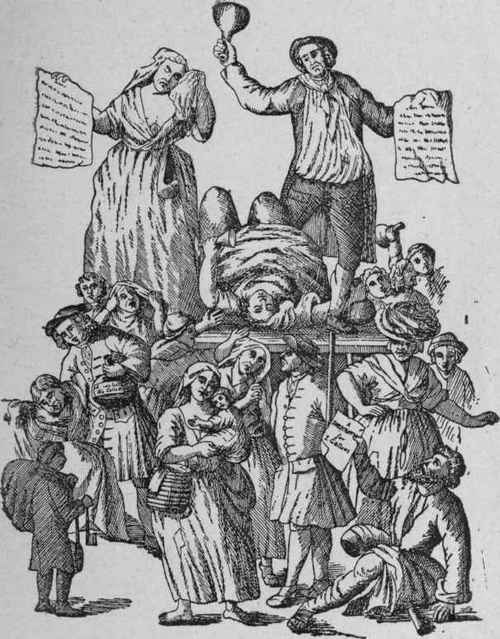
"The Scene appears, and Madame's Crew In deep Despair, Exposed to view. See Tinkers, Cobblers, and cold Watchmen, With B------s and W------s as drunk as Dutchmen.
All mingling with the Common Throng, Resort to hear her Passing Song.
"Whilst Mirth suppress'd by Parliament, In Sober Sadness all lament, Pursued by Jekyl's indignation, She's brought to utter desolation. With Oaths they storm their Monarch's name, And curse their Hands that form'd the Scheme.
"All Billingsgate their Case Bemoan, And Rag-fair Change in Mourning's hung; Queen Gin, for whom they'd sacrifice Their Shirts and Smocks, nay, both their Eyes. Rather than She want Contribution, They'd trudge the Streets without their shoes on."
The following verses on the Gin Act, in 1736, are supposed by John Nichols to be the production of Dr. Johnson.
"Pensilibus fusis cyatho comitata Supremo,
Terribili fremitu stridula maeret anus. O longum formosa vale mihi vita decusque,
Fida comes mensae fida comesque tori! Eheu quam longo tecum consumerer aevo,
Heu quam tristitiae dulce lenimen eras. Aeternum direpta mihi, sed quid moror istis,
Stat, fixum est, nequeunt jam revocare preces; I, quoniam sic fata vocant, liceat mihi tantum,
Vivere te viva te moriente mori."
A clever cento from the Latin poets, which may be thus represented in English:
". . . Left with her last glass alone, Thus loud laments her lot, the squeaking crone: Farewell, my life and beauty, thou art sped, Faithful companion of my board and bed. My earthly term fain with thee would I live, Who to my sorrowing heart can'st solace give. Bereft of gin, alas ! am I for aye! The Act is passed. 'tis all in vain to pray. Go where the Fates may call, and know that I Living, with thee would live, and dying, die !"
Hogarth's Gin Lane was advertised in 1751, with a note that, as its subject was calculated to reform some reigning vices peculiar to the lower class of people, in hopes to render them of more extensive use, the author had published them in the cheapest manner possible. "The cheapest manner possible" was one shilling which in those days was a fairly good price for a print. The following lame and defamatory verse was composed for the occasion by the Rev. James Townley:
Continue to:


My Books

