


Mint Julep. Continued
Description
This section is from the book "Drinks Of The World", by James Mew. Also available from Amazon: Drinks of the world,.
Mint Julep. Continued
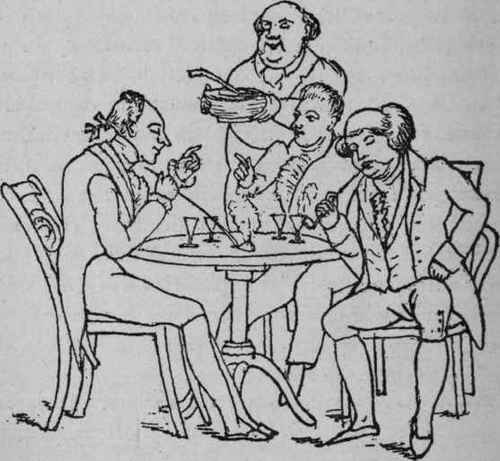
"A crown bowl of punch."
It has been said that of punches there are at least threescore. Here follow a few of the many varieties: Brandy, Sherry, Gin, Whiskey, Port, Sauterne, Claret, Missisippi, Vanilla, Pine Apple, Orgeat, Curacoa, Roman, Glasgow, Milk, and Regent's, brewed by George IV.; St. Charles', Louisiana, Sugar House, La Patria, Spread Eagle, Imperial, Rochester, and Rocky Mountain; Non-such, Philadelphia, Fish-house, Canadian, Tip-top, Bimbo, Nuremburgh, Ruby, Royal, Century Club, Duke of Norfolk, Uncle Toby, and Gothic.
People have immortalised themselves by the invention of punches to which a grateful country has attached their names. Of these famous ones are General Ford, for many years commanding engineer at Dover; Dr. Shelton Mackenzie, of Glasgow; D'orsay; and M. Grassot, the eminent French comedian of he Palais Royal, who communicated his. receipt to Mr. Howard Paul, the equally, eminent entertainer, when performing in Paris.
Last, though not least, the military have thus distinguished themselves by the National Guard, the 7 th Regiment Punch, the 69th Regiment Punch, the 32nd Regiment or Victoria Punch, and the Light Guard Punch.
The sangaree, originally a West Indian drink, is as unsatisfactory in its explanation as in its etymology. It seems, indeed, to be little more than spirit and water, with sugar and nutmeg to taste. It very nearly approaches, if it is not identical with, toddy.1
Shrubs 2 are unsatisfactory, like sangarees. They seem to have no distinctive or differentiating feature. The most common kinds are Rum, Brandy, Cherry, and Currant.
Slings are very closely related to toddies. Their difference is, indeed, infinitesimal, so far as we are able to learn.3
1 Such at least is the signification of sangaree as far as American drinks are concerned. But Sang-gris is said by Bescherelle to be a mixture of tea in wine amongst the sailors of the North. Perhaps the name is taken from the colour. It recalls David Garrick's "Why, the tea is as red as blood." In the West Indies it is made of Madeira, water, lime juice, and sugar. Spices are sometimes added. Pinckard's "West Indies," i. 469.
2 Shrub is called santa in Jamaica. It is made in the West Indies with rum, syrup, and orange-peel.
3 The Slang Dictionary, however, defines Sling as a drink peculiar to Americans, generally composed of gin, soda-water, ice, and slices of lemon. At some houses (understand public) in London gin slings may be obtained. Francatelli has an exquisite note on Gin Sling, which he directs to be sucked through a straw. "I fear that very genteel persons will be exceedingly shocked at my words; but when I tell them that the very act of imbibition through a straw prevents the gluttonous absorption of large and baneful quantities of drink, they will, I make no doubt, accept the vulgar precept for the sake of its protection against sudden inebriety."
Of the smash, even Jerry Thomas speaks slight-ingly. He says, "This beverage is simply a julep on a small plan." It, however, can boast of three species - gin, brandy, and whiskey, and for all a small bar-glass must be used. It is usual, though not appar-ently essential, to lay two small pieces of orange on the top, and to ornament with the berries of the season.
Toddy is the Hindustani tari tâdi, or juice of the palmyra and cocoa-nut. Tar is the Hindustani word for a palm. It is the name given by Europeans to the sweet liquors produced by puncturing the spathes or stems of certain palms. In the West Indies. toddy is obtained from the trunk of the Attalea cohune, a native of the Isthmus of Panama. In South-eastern Asia the palms from which it is collected are the gomuti, cocoa-nut, palmyra, date, and the kittul (Caryota urens). When newly drawn the liquor is clear, and in tas te resembles malt. In a very short time it becomes turbid, whitish, and sub-acid, quickly running into the various stages of fermentation, and acquiring an intoxicating quality.
In our use of the word, toddy seems to mean nothing more than spirit and water sweetened, with the occasional addition of lemon peel. Whiskey toddy is the common and favourite species, though there are also apple, gin, and brandy toddies. Toddy differs from grog in being always made with boiling water, but this distinction is not universally maintained, nor, indeed, used by the best authors. Whiskey is pro-bably the "vulgar" kind alluded to by Anstey in his Pleader s Guide, Lect. 7.
"First count's for that with divers jugs, To wit, twelve pots, twelve cups, twelve mugs, Of certain vulgar drink called toddy, Said Gull did sluice said Gudgeon's body."
The names of American drinks form an amusing study. Passing over the well known sleepers, sifters, flosters, knickerbockers, ching-chings, Alabama fog-cutters and thunderbolt cocktails, the lightening smashes and eye-openers of Connecticut, the corpse revivers, the Mother Shiptons and the Maiden's Prayers, we propose to give a list of some of the most remarkable titles, with receipts added, to satisfy the appetite of any who care to compound them.
A Yard of Flannel. A yard of flannel, otherwise called egg flip. - Boil a quart of ale in a tinned saucepan. Beat up yolks of four with the whites of two eggs. Add four table-spoonfuls of brown sugar and a soupcon of nutmeg. Pour on this by degrees the hot ale, taking care to prevent mixture from curdling. Pour back and forward repeatedly, raising the hand as high as possible. This produces the frothing and smoothness essential to the goodness of the drink. It is called a yard of flannel from its fleecy appearance.
White Tiger's Milk (a la Thomas Dunn English, Esq.). Half a gill apple jack, 1/2 gill peach brandy, 1/2 tea-spoonful aromatic tincture,1 white of an egg well beaten. Sweeten with white sugar to taste. Pour the mixture into 1 quart of milk, stir well, and sprinkle with nutmeg. This receipt will make a quart of the compound.
1 Aromatic tincture: Ginger, cinnamon, orange peel, each 1 oz.; valerian, 1/2 oz.; alcohol, 2 quarts. Macerate for fourteen days and filter through unsized paper.
Continue to:


My Books

