


The Drinks Of Antiquity. Continued
Description
This section is from the book "Drinks Of The World", by James Mew. Also available from Amazon: Drinks of the world,.
The Drinks Of Antiquity. Continued
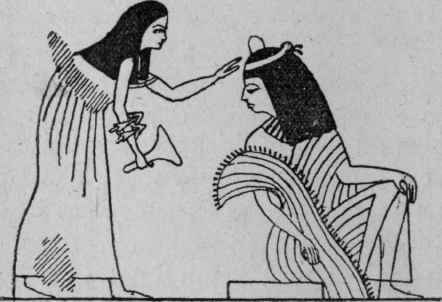
1 See tailpiece, where a servant is coming to the assistance of her mistress.
2 Jablonski is our authority for supposing it primarily an Egyptian.
This zythum is nearly allied to the sacera of Palestine, the cesia of Spain, the cervisia of Gaul, the sebaia of Dalmatia, and the curmi or camum of Germany. According to Rabbi Joseph, this beer was made 1/3 barley, 1/3 Crocus Sylvestris, and 1/3 salt. He adds, "He that is bound, it looseth; and he who is loose, it binds; and it is dangerous for pregnant women." absinthe, etc., which probably answered the purpose of our modern "bitters."
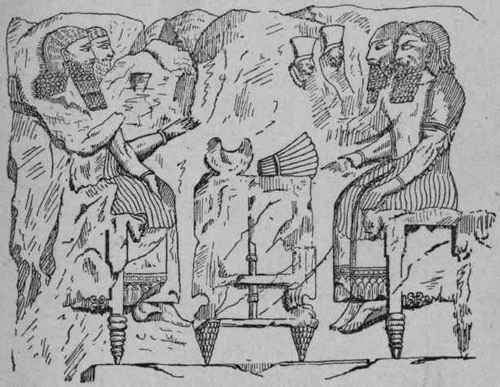
The Assyrians, who rank next in antiquity to the Egyptians, were no shunners of wine; they could drink sociably, and hob-nob together, as we see by the accompanying illustration.
Their wine cups were, in keeping with all the dress and furniture of the royal palaces, exceedingly ornate; and it is curious to note the comparative barbarism of the wine skin, and the nervous beauty of the wine cups being filled by the effeminate eunuch. The numerous bas-reliefs which, happily, have been rescued, to our great edification, afford many examples of wine cups of very great beauty of form. The inscriptions give us a list of many wines, and among them was the wine of Helbon, which was grown near Damascus, at a village now called Halbun. It is alluded to in Ezekiel xxvii. 18: "Damascus was thy merchant, by reason of the multitude of the wares of thy making, for the multitude of all riches; in the wine of Helbon, and white wool."
Wm. St. Chad Boscawen, Esq., the eminent Assyriologist, has kindly favoured us with the following illustration and note on the subject of Assyrian wines:
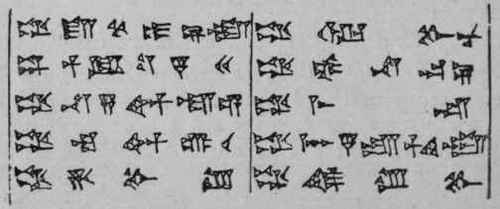
"This list of wines is found engraved upon a terracotta tablet from the palace of Assur-ba-ni-pal, the Sardanapalus of the Greeks, and evidently represents the wines supplied to the royal table. It reads: Col. I. Wine of the Land of Izalli.
Wine, the Drink of the King (Daniel i. 5). Wine of the Nazahrie. Wine of Ra-h-u (Shepherds Wine). Wine of Khabaru. Col. II. Wine of Khilbunn or Helbon.
Wine of Arnabani (North Syria). Wine of Sibzu (Sweet Wine). Wine of Sa-ta-ba-bi-ru-ri (which I think means Wines which from the Vineyard come not). Wine of Kharrubi (Wine of the Carrob or Locust bean)." On Phillips's Cylinder (col. i. 1. 21-26) is a list of wines which Nabuchodorossor is said to have offered: "The wine of the countries of Izalla, Touimmon, Ssmmini, Helbon, Aranaban, Souha, Bit-koubati, and Bigati, as the waters of rivers without number." And among the inscriptions deciphered appear a long list of wines which the Assyrian monarchs are said to have carried into their country as booty, or to have received as tribute.
We see the process of filling the wine cups at a feast. They were dipped into a large vase instead of being filled from a small vessel. Nor were they alone contented with grape wine, they had palm wine, wine made from dates, and beer even as the Egyptians had.
According to the Abodah Zarah, a treatise on false worship, there was a mixed drink used in Babylon called Cuttach, which possessed marvellous properties. "It obstructs the heart, blinds the eyes, and emaciates the body. It obstructs the heart, because it contains whey of milk; it blinds the eyes, because it contains a peculiar salt which has this property; and it emaciates the body, because of the putrefied bread which is mixed with it. If poured upon stones, it breaks them; and of it is a proverb, 'that it is better to eat a stinking fish than take Cuttach.' " The same treatise also mentions Median beer and Edomite vinegar.

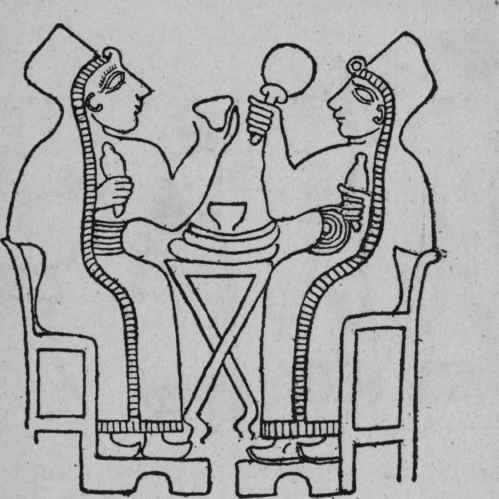
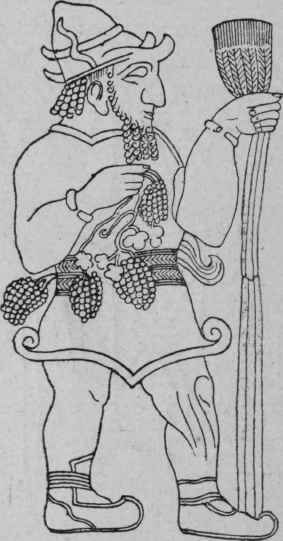
The Hittites had been a powerful and civilized nation when the Jews were in an exceedingly primitive condition, and Abraham found them the rightful possessors of Hebron, in Southern Palestine (Gen. xxiii.), and so far recognised their rights to the soil, as to purchase from them the Cave of Machpelah for "four hundred shekels of silver, current money with the merchant." Their power afterwards waned, as they had left Hebron and taken to the mountains, as was reported by the spies sent by Moses, four hundred years afterwards (Num. xiii.), but they have left behind them carvings which throw some light upon their social customs. For instance, here is one of two ladies partaking of a social glass together. Unfortunately, we do not know at present the true meaning of their inscriptions, for scholars are yet at variance as to the translation of them. That they thoroughly cherished Wine may be seen from the accompanying illustration, which represents one of their deities, who appears to be a compound of Bacchus and Ceres, and aptly illustrative of the two good things of those countries, Corn and Wine, which, with the Olive and Honey, made an earthly Paradise for the inhabitants thereof. It shows how much they appreciated Wine, when they deified it.
As to the Hebrews, they were well acquainted with wine, and placed Noah's beginning to be a husband man, and planting a vineyard, as the earliest thing he did after the subsidence of the flood. Throughout their sacred writings, Wine is frequently mentioned, and intoxication must have been very well known among them, judging by the number of passages making mention of it. A great variety of wines is not named - nay, there are only two specifically mentioned: the Wine of Helbon, which, as we have seen, was an article of merchandise at Damascus, a fat, luscious wine, as its name signifies; and the wine of Lebanon, which was celebrated for its bouquet. "The scent thereof shall be as the wine of Lebanon" (Hos. xiv. 7). It is possible that this bouquet was natural, or it might have been artificial, for it was the custom to mix perfumes, spices, and aromatic herbs so as to enhance the flavour of the wine, as we see in Canticles viii. 2: "I would cause thee to drink of spiced wine of the juice of my pomegranate;" by which illustration we also see that the Hebrews made wines other than those from grapes.
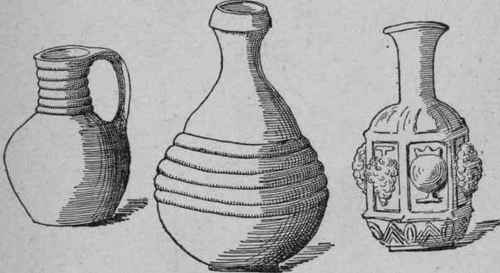
That it was commonly in use is proved, if it needed proof, by the miracle at the marriage at Cana, where the worldly-wise ruler of the feast says, "Every man at the beginning doth set forth good wine; and when men have well drunk, then that which is worse: but thou hast kept the good wine until now." That they drank water mixed with wine may be inferred by the two verses (Prov. ix. 2, 5): "She hath mingled her wine"; "Drink of the wine that I have mingled.' Their wine used to be trodden in the press, the wine being put into bottles or wine skins, specially mentioned in Joshua ix. 4, 13. In later days they had vessels of earthenware and glass, similar to those in the illustration, which were found whilst excavating in Jerusalem.
That the ancient Jews knew of other intoxicating liquors, such as Palm and Date wines, there can be very little doubt.
Continue to:


My Books

