


Tea
Description
This section is from the book "Tea, Coffee, And Cocoa Preparations", by Guilford Lawson Spencer . Also available from Amazon: Tea, coffee, and cocoa preparations.
Tea
Tea is prepared from the various species of Thea. This plant is a hardy evergreen shrub.
Statistics Of Tea Consumption
The extent of the consumption of teas is shown by the following Statements obtained from the United States Treasury:
Imports of tea 1ess the amount exported.
1890. | 1889. | 1888. 1887. | |
Pounds. 83,494, 956 | Pounds. 79,192, 253 | Pounds. 83,944, 547 | Pounds. 87,481,186 |
The present per capita consumption of tea in the United States is approximately 1.3.3 pounds.
We derive about 51 per cent of our tea from China, 42 per cent from Japan, and all but a small fraction of a per cent of the remainder from the British possessions.
General Classification
Teas are usually designated as black or green, the name depending Upon the color of the prepared leaf, due to the methods of curing and not, as formerly supposed, to differences in species.
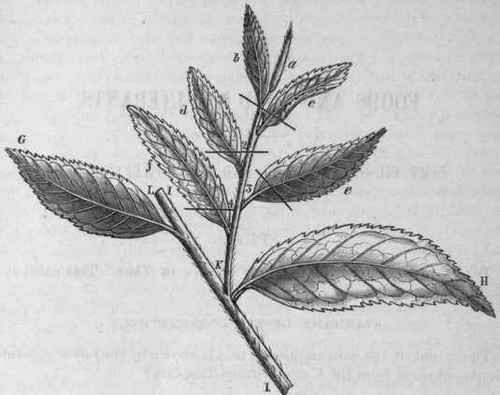
Col. Money,1 in his work on tea cultivation, gives an illustration, from which the following is taken, indicating the leaves which constitute
1Tea cultivation, 3d ed., page 102 et seq., Lient. Col. Money; London, W. B. Whiting-ham & Co. each of the different kinds of tea as classified according to the age of the leaf.
W.Scholl del
Fig. 27. - a, Flowery Pekoe; b, Orange Pekoe; c, Pekoe; d, Souchong 1st; e, Souchong 2nd; f, Congou. - a, b (when mixed together), Pekoe; a, b, c, d, e (when mixed together), Pekoe Souchong.
If there he another leaf below f, and it he taken, it is named and would make Bohea.
Each of these leaves was first a flowery Pekoe leaf (a), it then became h, then c, and so on.
At the base of the leaves c, d, e, f, exist buds 1, 2, 3, 4, from which new shoots spring.
Methods of Manufacture
The methods of preparing teas differ in the different countries in which this commodity is grown. In India the manufacturing processes are very much simplified, and the greater portion, if not all the work, is accomplished by machinery; thus the leaves only come in contact with the hands of the laborers in picking.
Continue to:


My Books

