


Measuring Gas
Description
This section is from the book "A Manual Of Home-Making", by Martha Van Rensselaer. Also available from Amazon: A Manual of Home-Making.
Measuring Gas
How to read a gas meter.
The index of an ordinary gas meter, which is similar to that of an electric or a water meter, is shown in Fig. 41. The smaller top dial, which is marked "Two feet" inside of the circle, is generally called the "testing circle" or "proving head," and is used principally in testing the meter. One revolution of the hand of the testing circle indicates that 2 cubic feet of gas have passed through the meter. In some meters one revolution of the hand of the testing circle represents more or less than 2 cubic feet of gas and the testing circles are correspondingly marked. The indication of the hand of the testing circle is ignored in the ordinary reading of the meter.
Cubic Feet marked "1 thousand," the second dial will be marked "10 thousand," the third " 100 thousand," and so on. The reading of the index, as illustrated in Fig. 41 is as follows:

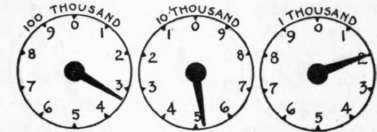
Fig. 41. - The index of a gas meter. Each dial is marked with the volume of gas passed a revolution. The smaller top dial, which is marked "Two Feet" inside of the circle, is generally called the "testing circle" or " proving head" and is used principally in testing the meter.
Of the large dials the first one at the right is usually marked "1 thousand." This means that during one complete revolution of the hand, 1000 cubic feet of gas has passed through the meter. This dial is divided into ten equal parts so that the passage of the hand over each part indicates the passage of one-tenth of 1000 cubic feet, or 100 cubic feet. For most meters, it may be said of the other dials that the complete revolution of each hand indicates the passage of ten times as much gas as one revolution of the hand of the dial of next lower denomination (usually the one to the right). The figure representing the number of cubic feet discharged during one revolution of the hand is written over each dial. Thus if the first dial is

Cubic Feet

Fig. 42. - Gas meter index reading 79,500 cubic feet.
Reading of "1 thousand" dial.............. 200 cubic feet
Reading of " 10 thousand" dial............. 5 000 " "
Reading of "100 thousand" dial............30 000 " "
Complete reading of the meter........ 35 200 " "
It is not necessary to write down separately the reading of each dial, but it is much shorter to set down from right to left the figure last passed by the hand of each dial, commencing with the dial of lowest denomination and then - if the dial of lowest denomination is marked "1 thousand" - appending two zeros to the resulting figures.
If a hand is very nearly over one of the figures on a dial, it is impossible to tell without consulting the dial of next lower denomination whether the figure under the hand or that just previously passed by the hand should be read. For example, in Fig. 42 the hand of the "100 thousand" dial is over 8, and considering this dial alone the reading might be taken as 8; but it is seen that the reading of the "100 thousand" dial cannot have reached 8, since the hand of the dial to the right (the "10 thousand" dial) has not reached zero. The reading of the "100 thousand" dial is therefore 7, and the correct reading of the entire index is 79 500 cubic feet.
To satisfy one's self that the gas company does not make a mistake in reading the meter, it is well for the consumer, occasionally at least, to read his meter at as nearly as possible the same time that the gas company reads it. Usually the gas company's bill will state the meter readings on the dates between which the bill applies, so that checking meter readings will be easy. If the meter readings are not given on the bill, the consumer can determine what the amount of his bill should be if he knows the meter readings and the price of gas a thousand cubic feet. Should the consumer take one meter reading at the proper time and then miss the next one or two, it is obvious that he can still check up the gas bills by taking a reading at the next convenient time when the company's reader calls, calculating the cost of gas used between the dates of his readings and comparing this cost with the sum of the amounts of the bills rendered for gas between the same dates.
Cost of gas consumed an hour in appliances
With only a little trouble one can determine the cost an hour of operating a gas light, heater, or other gas-consuming appliance. To do this, one should have in operation the appliance in question and all other gas appliances supplied through this meter shut off. Then, by observing the "testing circle" of the meter, the time in seconds required for 1, 2, or more cubic feet of gas to pass should be determined. The number of cubic feet of gas used an hour is then determined in the following manner: (1) Divide the number of cubic feet burned during the test by the number of seconds, thus determining the number of cubic feet of gas used a second, and (2) multiply the result by 3600 (the number of seconds in an hour).
Example: It is observed that with a gas water-heater in operation, the meter indicates the passage of 2 cubic feet of gas in 1 minute and 40 seconds. Applying the above rule, 2 (cubic feet) is divided by 100 (seconds) (the equivalent of 1 minute and 40 seconds), which gives 2/100; 2/100 is multiplied by 3600, giving 7200/100, or 72. The water-heater is, therefore, using 72 cubic feet of gas an hour.
Knowing the cost of 1000 cubic feet of gas, one can easily calculate the cost an hour for gas used in the heater; for example, if gas were $1 for 1000 cubic feet, the 72 cubic feet would cost 72 times 1/1000 of $1, or 7.2 cents, which is the cost an hour for gas.
Causes of high bills for gas
If a consumer's gas bill for a certain period greatly exceeds that of the previous period, it is due to one or more of the following causes:
1. An increased consumption of gas. A careful consideration of the use made of gas during the period covered by the bill will very often reveal the fact that an unusual amount of gas has been consumed. Baking, canning of fruit, entertaining, the coming of long winter evenings, and the like are a common cause of increased gas consumption resulting in larger bills than usual. Leaks in the gas pipes of the house may produce the same results.
2. An error of the gas company in reading the meter or in office work. If the consumer reads his own meter and checks the bill, the question as to whether this cause is operative can be quickly ascertained.
3. A fast meter. If the two above causes apparently do not exist, the consumer will naturally consider that his meter is fast.
The best procedure for the consumer who thinks his meter incorrect varies with the locality. Many of the larger cities are provided with meter-inspection departments, under the supervision of the city or state, and the consumer can have his meter tested by this department. If his meter is found to be fast in excess of the established tolerance, the company usually pays the fee for the test and refunds to the consumer a certain amount, depending on the magnitude of the error of the meter and the probable length of time that the consumer has been thereby overcharged. If the meter is found to be within the tolerance, or "slow," the consumer usually pays the fee (about $1), and may have to pay the gas company for the probable amount he has been undercharged.
Continue to:


My Books

