


Brewing Utensils
Description
This section is from the book "Warne's Model Housekeeper", by Ross Murray. See also: Larousse Gastronomique.
Brewing Utensils
Every brewhouse, large or small, must have its plant or proper utensils; these are -
1. The copper for the liquor or wort, or when possible two coppers are better, one for the water and one for the wort.
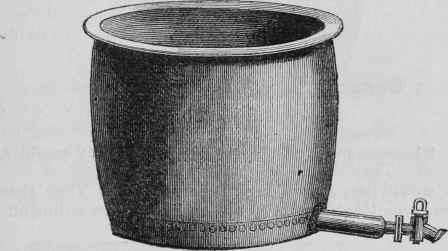
Brewing Copper.
2. The mash tub, which is a tub with a false bottom some inches above the true bottom. It is bored full of small holes through which the wort is drained from the malt. These holes must be examined occasionally to see that they do not get choked up. If they are, a skewer should be made hot and they should be repierced with it.

Mash Tub.
For home use a wine butt cut down, with a false bottom put in it, answers every purpose.
3. The oar or rudder, anciently called the Penstoff, for stirring up the malt in the mash tub.
4. The underback - that is, a tub to receive the wort as it comes out of the mash tub. The upper part of the cut-down wine butt would answer for it.

Underback.
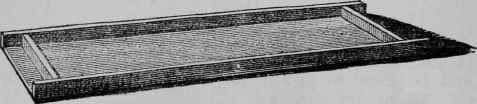
5. The Coolers
These are oblong shallow vessels. They should be raised at one end to allow the wort to run off free of the sediment.
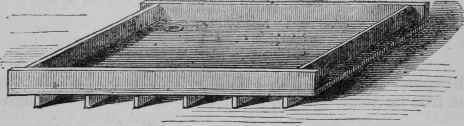
Cooler.
6. The Fermenting tun; it should be large enough to hold the whole brewing; but the mash tub, with the false bottom taken out, can be used.
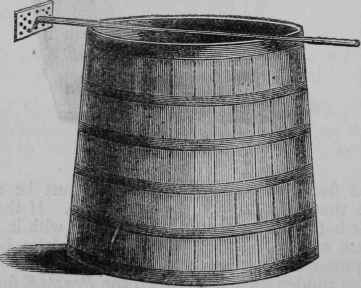
Fermenting Tun and Rouser.
And we may observe here, that the grains taken out are of great use for feeding cows and pigs.
7. Casks and oak-stands to place them on. As to size and number, they will depend on the quantity required.
8. Stillions - i.e., flat wooden troughs in which the vats or barrels stand while the yeast is coming over.

Stillion.
9. A thermometer in a tin case made for brewers.
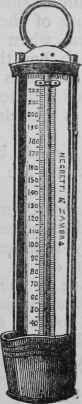
Thermometer.
10. The Saccharometer - unnecessary in private brewhouses.
11. A few tap tubs, with iron hoops.
12. Six tin spouts for the beer to work through when in the casks.
13. A whisk for the yeast.
14. A bushel measure to measure the malt.
15. A tub and skimmer for the yeast.
Tap Trough.
Continue to:


My Books

