


Domestic Pets. Birds. Part 5
Description
This section is from the book "Warne's Model Housekeeper", by Ross Murray. See also: Larousse Gastronomique.
Domestic Pets. Birds. Part 5
The beautiful little avadavats and waxbills I have kept, and I can thoroughly recommend them as pets for the drawing-room or conservatory. In the latter atmosphere they flourish best, for they are rather delicate birds, and do not like changes of temperature. The Avadavats are very small red and brown birds, and with their bright red beaks, spreading fan-like tails, and spotted plumage, are exceedingly pretty. They sit in a line on a perch as close as possible together, and are very affectionate. Their song is sweet and soft, and one will stand up and warble for a few minutes, and then sit down, and another will spring up and sing and subside into quietude, and so on. It is the prettiest thing imaginable to see a number of these little creatures in a cage of delicate workmanship, darting about, pluming themselves, washing, and singing, and appearing so thoroughly happy. They live very sociably with Silver Beaks, Cordon Bleus, and Australian, African, St. Helena, Orange, and Zebra Wax Bills, which are about their own size, and require the same food and warmth. They feed chiefly on millet-seed, but will eat canary-seed as well, and must be abundantly supplied with water.
It is necessary, however, to take precautions against their being chilled by being too constantly in the bath, especially in winter. They are so fond of washing that they will get into their water-glass, if possible, all day long, and I lost several of my birds from excessive bathing: I could not keep them out of the water, and when the sun was not shining, of course they could not get dry or warm for some time after they had been ducking themselves so thoroughly. I kept them in a cage made on purpose for them, with fine silver wires and glass sides round the lower half of the cage; but I do not think this answered for them. The glass prevented the floor from getting dry quickly after it had been wetted by the splashing of the water, and it never looked clean for the same reason - it was so constantly splashed. The wires must be small and closely put together, as the birds would get out between the wires of an ordinary cage; but I think tin wire is preferable to silver, and more easily kept clean. The birds must have a thick covering at night, and never be exposed to chilling draughts.
A conservatory or greenhouse, kept at a moderate degree of heat always, is certainly the most desirable abode for these little foreigners.
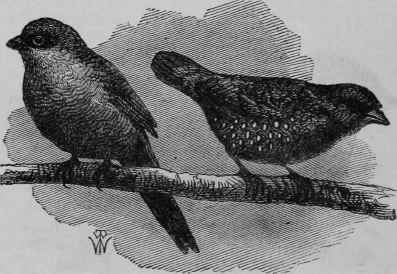
Avadavat and Wax Bill.
An article on domestic pets seems scarcely complete without some notice of parrots and parrakeets; but there are so many varieties of this tribe of birds, and they come from so many parts of the world, that they require a book to themselves. I can only make a few suggestions for their treatment generally. Those which are natives of tropical climates require warmth and abundance of farinaceous food and fruit. Bread and milk should be the staple prison diet of parrots (the bread should be soaked first in boiling water, squeezed as dry as possible, and then allowed to absorb as much fresh boiled milk as it will hold), adding Indian corn, biscuits, nuts, almonds (not bitter almonds), fruit (hard and soft), peach and plum kernels, cherries; grapes, pears, etc, grain, and seed for the larger birds; and the smaller kinds should have hemp, canary, and millet seeds, with fruit. All should have water for drinking and bathing within reach; and if the birds will not go into water, it is well to sprinkle a little warm water on them occasionally, and put them into the sunshine that they may plume themselves and clean their feathers. Great cleanliness is necessary to keep parrots in health, and their feet must be frequently washed if they get dirty and they will not bathe themselves.
They are subject to diseased feet, and their perches should be covered with flannel, and the bottom of the cage should have a grating with a drawer underneath it always covered with sand. Lettuce or water-cress may be giver to these birds occasionally; and it is said that a chili-pod given from time to time is useful - when they are moulting they may have one or two cut up small once a week. If they have an attack of asthma they should have a few grains of cayenne-pepper mixed with their bread and milk. Meat, sugar, and sweetmeats, are all unwholesome for parrots.
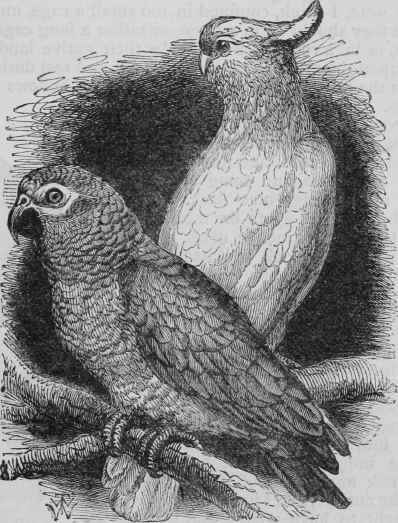
Grey Parrot and Cockatoo.
Within the last few years a great number of the Australian grass parra-keets have been brought to England. They were very expensive at first, but I should suppose they must be cheap now, for I hear of some thousands being brought over at once for sale. They are very delightful pets, and their plumage is very beautiful: one of the most charming is the warbling grass parrakeet or budgerigar, which is said to breed in captivity. Those which I kept were, I think, confined in too small a cage, and to see them to advantage they should be in a large, or rather a long cage, along which they can run, or in a room or aviary. In their native land they feed in large flocks upon the grass seeds in the plains, and rest during the heat of the day upon the branches of the gum-trees, in the hollows of which they lay their eggs. Their plumage is very beautiful; green is the prevailing colour, but it is very much spotted with black, and the breast and under tail feathers are yellow, and some of the feathers of the wings blue-black. They have bright blue spots on the cheeks, and the only distinctive mark of the sexes is, that the cock bird has bluish nostrils and the hen brown ones.
They are very loving birds, and are continually caressing each other, keeping up a constant chirping and chattering all the time. My pair would sometimes flap their wings and utter a harsh disagreeable cry, but I think this was owing to their dislike to the smallness of their cage. I put a cocoa-nut into it in the hope that they may be induced to breed, but they never took any notice of it, except to bite the outside, and I imagined that they ought to have a cage four feet long to live in, and to be left in a much quieter room than mine was; they are shy birds, and I could never succeed in making mine familiar with me - they were never tempted by any dainty I could offer them, and, indeed, never approached any food to which they were not accustomed, so that I could not change their diet: the only treat they had was a bundle of oats, out of which they could pull the grain, and that they appeared to like, I used sometimes to let them out of their cage, and their great delight was to run along the green bars of the Venetian blinds; but they were so crafty that I found it impossible to catch them, and sometimes had to wait till late in the day before hunger induced them to return to their cage, and then they would often pop in and out again before any one could shut the door of the cage.
They lived very contentedly in the large winter cage with the canaries, but took very little notice of them, being too much occupied with one another to care for others. The hen is said to lay her two eggs about Christmas, and to be a very attentive mother, but I could not get mine even to enter the cocoa-nut I was told to provide for a nest. These birds seemed to like to get hold of a large piece of gravel to carry about the cage, so I put a piece of charcoal in for them, but I do not think they touched it. I always gave them water, but they did not drink much, and I never saw them bathe, although Australian travellers speak of flocks of them coming regularly every evening to the springs of water. Like the love-birds, which they much resemble, these parrakeets are unhappy alone, and must always have a companion.
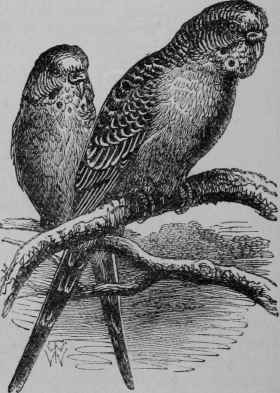
Australian Parrakeets.
Continue to:


My Books

