


Domestic Pets. Goldfinch
Description
This section is from the book "Warne's Model Housekeeper", by Ross Murray. See also: Larousse Gastronomique.
Domestic Pets. Goldfinch
The goldfinch is an universal favourite, both from its beauty and sprightliness: it is very restless in a cage, and therefore I do not think it appears as contented as some less active birds; but it will live many years in confinement, and in an aviary is as happy as possible. It ought not to have a bell-shaped cage, as it is apt to grow giddy, twirling its beak along the wires. It is very easily tamed, and is capable of great attachment to its owner, and may generally be safely allowed a flight round the room while its cage is being cleaned. I had one which would fly across the room to me as soon as its cage door was opened, and perch on my shoulder for its favourite food of hemp-seed. It is rather fond of eating, I think, and takes so much exercise that I suppose it requires plenty of food. It will not sing without a few hemp-seeds in the day, but it must not be fed solely upon this heating seed. Canary, rape, and poppy-seed should be the ordinary food of goldfinches. Lettuce, groundsel, chick-weed, and water-cress they should have frequently, and plantain in the winter; in the wild state they feed much on thistle-seed, and they should often have a thistle-head given to them, to pick the seeds out of it for themselves.
They ought not to have sugar or sweet cakes, but they exceedingly enjoy a treat of biscuit, and Reading cracknels are very wholesome for them, and thoroughly appreciated by goldfinches, bullfinches, and canaries.
The goldfinch is a very tractable bird, and there are many accomplishments which he will learn, and seems to exhibit with pleasure. He may be taught to fire off a small cannon, to feign death, and stand unmoved while fireworks are let off close to him, to mount a ladder, etc.; but I fear when these tricks are made use of by his master to exhibit in public for pay, he is often treated with cruelty to make him a proficient in them. Many very harmless accomplishments he will learn, however, merely by patience and kindness on the part of his teacher - to open a box for his seed, to ring a bell when he wants food, to drag a little waggon up an inclined plane into his cage, and to draw up water from a little well underneath it. All these are easily taught, and the bird really seems to find pleasure in such little tasks. One of my birds who lived in a cage so constructed as to have the seed always in a box of which he had to lift up the lid, and the water in a well to be drawn up in a bucket, was quite unhappy when his home was undergoing repair, and he had to live for a time in an ordinary cage, and sang his merriest song when he had to go to work with his little chain and pail again.
I taught him to lift the lid of the box by having it open for one day, and then gradually lowering it by means of a piece of silk put round it, fastened at the back of the cage, till it was quite shut. He very soon found out that he must lift it up with his beak in order to reach the seed; and at last he became so crafty about it, that he would take out two or three seeds at once, and put a reserve by his side between the wires while he ate one. The cage was made with a wooden back, and the box was let into this above the door, and the lid fastened to the inside with two little hinges (care should be taken that the lid is not too heavy for the bird to lift easily, and that it should fall at once when not held up); a little bow window was constructed in the front of the cage, in the floor of which was a little hole with a wire across it, to which was attached a light silver chain fastened to a silver bucket about the size of a thimble. A small coloured glass tumbler was fixed below the bow window, by means of four strong wires and a ring. This was filled with water and the bucket dropped into the well, and the bird hauled up the chain with his beak, holding each fresh haul with his feet till the bucket came to the hole, and he could drink out of it.
I taught him this accomplishment by filling the bucket with water, and putting it on the floor of the bow window to accustom him to look for water there then I let it down by means of the chain pushed through two of the side wires by degrees, lowering it a little more every day. At first the bird pulled up the short bit of chain with his beak, and let it go before he could drink out of the bucket, but he gradually found out that he must hold the chain when he had drawn it up, and when he had once succeeded in doing this his education was finished; he never forgot the art, and often showed his delight in his task by singing when he had drawn up the bucket while his chain was under his feet, before he quenched his thirst. Of course it is necessary to see that the machinery of the bucket, chain, and well is always in order; any hitch preventing the bucket from falling into the well and getting re-filled with water would cause the poor little bird to die of thirst. The bullfinch and siskin will readily learn this accomplishment, and I had a mule bird (whose parents were a goldfinch and canary) who learned it very quickly; but I never succeeded in teaching a canary to put his foot on the chain, though he would pull it up with his beak readily enough - of course, always to be disappointed by the falling down of the bucket.
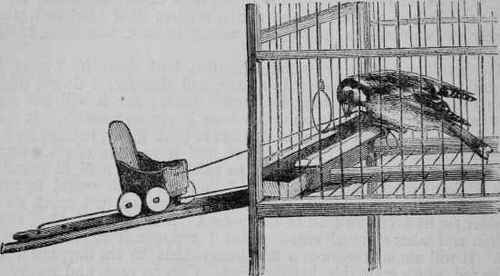
A goldfinch will learn to pull a little waggon up an inclined plane in the same way, and to take his seed out of it, the chain attached to the waggon having to be hauled in and held in the same manner. The way to teach him to ring for his food, is to suspend a little bell in a corner of his cage, and when he has been an hour or two without food, to ring it by means of a string attached to it, and immediately to place some of his favourite seed in the glass. In a few days he will discover that whenever the bell rings he gets a meal, and will seize the string, and peal away merrily whenever he is hungry.
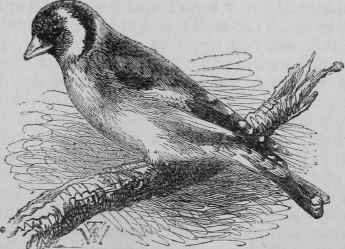
Goldfinch.
The goldfinch is rather subject to epileptic fits, and whenever he is seized with one, he should be plunged head downwards into cold water, and one or two dips will restore him at once. He is a large eater, and in all probability has indulged his appetite too much, so that he must be kept upon a low diet of lettuce seed and thistles, and have no hemp-seed for a few days after he has had one of these fits.
Continue to:


My Books

