


Modern Carriages. Continued
Description
This section is from the book "Warne's Model Housekeeper", by Ross Murray. See also: Larousse Gastronomique.
Modern Carriages. Continued
The Skeleton Phaeton
Is the lightest four-wheel carriage there is; it is not often used except where great lightness is required. To look well it must be very neatly and stylishly built. Price about 60/.
The Gig
Or Buggy, as it is generally called, is a two-wheeled carriage for one horse. Of late years they have gone very much out of fashion, particularly in town, but are still used in the country. Price about 60/.
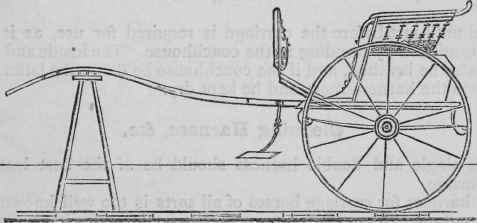
The Gig.
The Dog Cart
Is a two-wheeled carriage, to carry either two or four; the seats are placed back to back. They are very useful in the country to take a party to cover, or on shooting and fishing excursions, as they are strong, have a large boot for dogs, guns, and fishing tackle, and follow well. They require to be very nicely hung and properly balanced or they are very uncomfortable, particularly in the back seat. Price 60/. to 80/.
There are many other sorts and descriptions of carriages for horses and ponies, from the cheap basket carriage at 20/. up to almost any price.
All carriages should be washed as soon as they come in from use and while the dirt is wet, as, if allowed to dry on, the paint and varnish soon become scratched and worn, as few coachmen will take the trouble thoroughly to wet the mud again before trying to remove it, which seriously injures the carriage, by taking all the gloss off the paint, etc.
The dirt must first be well washed off every part of the carriage with plenty of water; the whole should then be dried with a sponge and leather, then any plate or brass should be wiped dry and clean, but need not be polished until just before the carriage is required for use, as it will get dull or tarnished by standing in the coachhouse. The inside and cushions should also be brushed, and if the coachhouse be damp the latter must be taken into the harness-room and be kept dry.
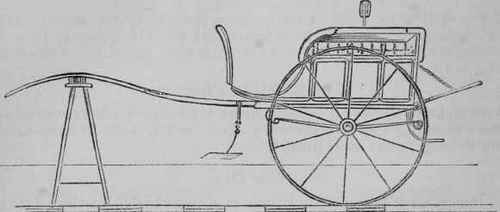
The Dog-cart.
Cleaning Harness, Etc
Both single and double harness should be of the best leather and workmanship.
The harness for carriage horses of all sorts is too well known to need repetition here; the only difference is that some prefer it very neat, and only use what is absolutely necessary, while others like it covered with plate or brass, and use as much as they can possibly get on the horse. The price will vary according to the amount of plate or brass-work on it. A set of single harness will cost from 12/. to 16/., or even more; and a set of double harness from 25/. to 35l. Care must always be taken that the collars are deep enough, otherwise the horse's shoulders will suffer. The proper way to fit a collar is to hold the horse's head up as high as he usually carries it when going, and then leave room to put the hand in comfortably.
Many horses, particularly those defective in the wind, go better in a pipe collar. On coming in from use, the bits, ferrets, etc, should first be removed, then the harness, if dirty, should be carefully washed clean, but not made more wet than is absolutely necessary, then dried in the harness-room, but not put near the fire; when dry it should be thoroughly done over with some harness paste or polish, and well brushed bright. The bits and terrets, etc, are also cleaned and polished and everything is ready for use.
Duties
The duty on every horse is 10s. 6d.; on every carnage with four wheels, 2/. 2s.; on every carriage with two wheels, 15s.; on every man-servant, 15s.
Continue to:


My Books

