


The Barometer. Part 2
Description
This section is from the book "Warne's Model Housekeeper", by Ross Murray. See also: Larousse Gastronomique.
The Barometer. Part 2
The barometer is highest of all during a protracted frost, and rises with a north-east wind, and when the air is very dry. The barometer falls very low in a thaw; it falls also when the wind comes from the moist quarters of the south and west. When the barometer stands above 300, no rain may be expected, the air is too dry for it. When the barometer stands very low indeed, short heavy showers and sudden squalls from the west may be expected.
As we have said, the sudden falling of the barometer denotes gales of wind, or, if the weather be very hot, thunder. In frosty weather the fall of the barometer foretells an approaching thaw. The barometer sinks lowest of all for wind and rain together. In winter the rise of the barometer foretells frost.
During frosty weather the rise presages snow. If in wet weather the barometer rises suddenly, the fine weather will not last. If the mercury fluctuates, expect changeable weather. In short, its upward motion signifies fine weather; its downward, wet or windy weather.
The barometer is highest in May, August, June, March, September, and April.
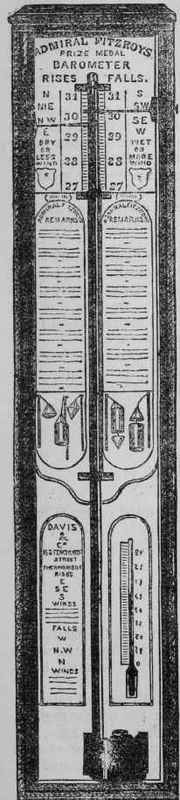
Davis's Prize Medal Barometer and Weather Guide.
The mercury is rising when the top of the column is convex, that is, higher in the middle than at the sides; it is falling when the top of the column is concave, that is, when it is hollow in the middle and higher at the sides.
The convex form is caused by the whole column not being able to rise together on account of the capillary attraction of the glass tube, which delays the part of the mercury which touches it, while the middle part is rising. The same cause - the capillary attraction of the sides of the glass tube - delays the fall of the sides of the column, and the centre sinks faster than the outside, and gives the column a concave shape at the top.
There are many natural prognostics of coming fine or foul weather. A red sunset with a tint of purple in it is a harbinger of a fair morrow. For when the air is dry it refracts the red or heat-making rays, and as dry air is not perfectly transparent they are again reflected in the horizon.
A red sunrise, on the contrary, forebodes wet.
A yellow or coppery sunset foretells rain. The yellow colour shows that the vapours of the air are already condensed into clouds. The rays of light meet with more resistance from condensed vapour, consequently those which are more refracted than the red - i.e., the yellow - are bent down to the eye. Moist air is more transparent than dry, and allows yellow rays, which have less momentum than red, to pass through it.
A grey sunrise is the harbinger of a fine day, for the air must be comparatively clear and free from moisture to let all the three coloured rays pass together, with a slight degree of intensity, so as to produce white light - for grey is only a modification of white. The old proverb truly says:
"Evening red and morning grey Will set the traveller on his way; But evening grey and morning red Will bring down rain upon his head".
A morning rainbow also presages wet, because it must necessarily be in the west, for it is always opposite the sun, which rises in the east; now rain clouds in the west almost always in this country bring bad weather. The old proverb is well known:
" A rainbow in the morning is the shepherd's warning; A rainbow at night is the shepherd's delight".
The rainbow at night is in the east because the sun is in the west, and as it shows that the rain clouds (if they have been driven from the west) are leaving us, it harbingers fine weather. If the wind be easterly, however, neither can be relied on.
A haze round the sun and a halo round the moon both foretell rain, for they are each caused by very fine rain suspended in the upper regions of the air, which will be sure to fall at last. The larger the halo, the sooner rain may be expected, because the clouds are nearer. Flowers also give out peculiarly strong and sweet odours before rain, chiefly because the vapour in the air prevents their perfume from ascending.
Swallows fly low before rain, because the insects on which they feed have descended from the cold regions of the air to the warmer air near the earth.
Seagulls come to land before stormy weather, because the fish on which they feed leave the surface of the sea, and they are driven for food to the worms and larvae which in such weather come out of the ground.
The Stormy Petrels* on the contrary go out to sea and run along the top of the waves, because their food (which consists of insects) is at such times to be found on the surface of the water; and their presence invariably predicts a storm.
"The different tribes of wading birds always migrate," says Sir Humphry Davy, " when rain is about to take place; and I remember once in Italy, having been long waiting in the end of March for the arrival of the double snipe in the Campagna of Rome, a great flight appeared on the 3rd of April, and the day after heavy rain set in which greatly interfered with my sport." Sir Humphry goes on by observing that many popular superstitions are owing to the same causes. "For anglers in spring," he says, "it is always unlucky to see single magpies, but two may be always regarded as a favourable omen; and the reason is that in cold and stormy weather one magpie alone leaves the nest in search of food, the other remaining sitting upon the eggs or the young ones; but when two go out together it is only when the weather is warm and mild and favourable for fishing".
Certain winds also influence the weather.
Wind is air set in motion by heat or cold. The air always seeks to preserve an equilibrium; therefore when hot air ascends, as it always does, cold air rushes into its place. Our highest winds are generally in December and January; March and November come next. The wind is stillest in August and September. High winds are caused in the cold months by the contrast between our temperature and that of the torrid zone; for the greater the contrast of cold and heat, the more violently will the air rush in to restore the equilibrium.
Continue to:


My Books

