


The Stable-Yard And Its Occupants. Part 4
Description
This section is from the book "Warne's Model Housekeeper", by Ross Murray. See also: Larousse Gastronomique.
The Stable-Yard And Its Occupants. Part 4
Partitions
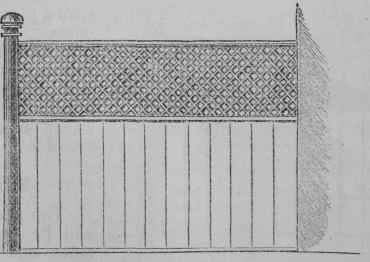
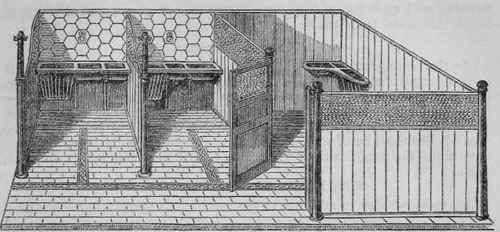
The partition for stalls will be match-lined both sides, and about four feet two inches high in rear, with a ramp and rising to six feet two inches towards the mangers; with iron pillar at the end next passage, with rings for pillar reins. Sometimes also the match-lining will be carried through in a level line, and the ramp formed by a cast-iron ornamental panel.
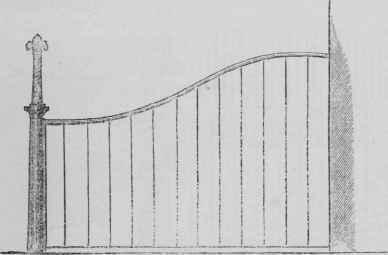
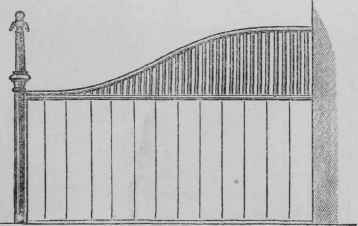
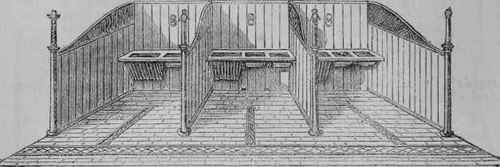
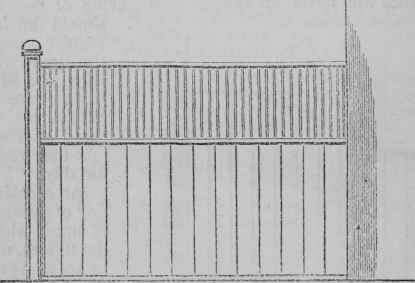
For loose boxes the boarding will be from five feet to about five feet four inches high at most, with a two-foot ornamental iron panelling over.
Mangers.
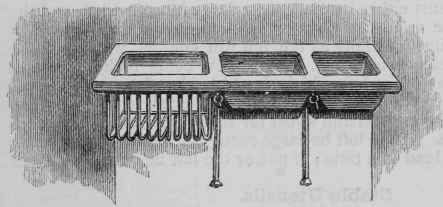
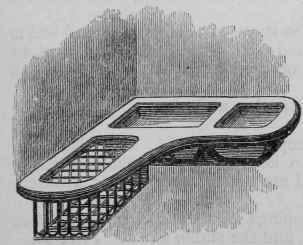
The best mangers are those containing hay-rack, corn manger, and water-trough in one, as per sketch; and we more specially recommend that preference should be given to galvanized iron.
The wall over the manger should be match-boarded to the height of partitions, and lined with iron hoop bands, sheet zinc over the joints of match-lining, or enamelled tiles, to prevent horses biting at it when being cleaned.
The manger will have two rings for halter reins, and a ring and galvanized chain fitted in wall over same.
Harness Room
This should be at least ten feet square, and have in it a fireplace fitted with range with boiler attached. A handy supply of hot water will be found most advantageous in the management of the stables, and we need not point out the necessity of a fire for drying the rugs, horse-cloths, saddles, harness, etc, in winter time.
This room should be fitted with convenient hooks and brackets for the hanging and cleaning of harness. These are of all sorts of designs, in which individual taste will be the best guide.
Coach-House
In the arrangement of the coach-house care should be taken that it be so situated that it have a long front to the yard, so that the carriages may be housed side by side, and not one behind the other; each carriage to have its doors, so that any particular carriage can be run in or run out without disturbing any of the others. When this is not practicable, the coach-house must be of sufficient depth to allow of two carriages standing one behind the other, with a space of at least eighteen inches between them.
Hay Loft And Corn Chamber
In most stables, in addition to the coachman's rooms, there is a corn chamber and hay-loft over the stable. The former is generally boarded off, lined all round with sheets of zinc or tin to keep out the vermin, and the door is provided with a lock, of which the coachman keeps the key, and gives out at stated times the corn for so many horses for so many days. By this means he keeps a check upon the consumption, and prevents waste and pilfering; both of which are more likely to occur when the supply is unlimited and easy of access. When there is not a regular corn chamber, one must either be made or a large bin provided, and the oats brought from the corn chandler as required, in quantities of two or three quarters at a time, as many as the bin will contain, which will be found a more expensive proceeding. Hay, from being bulky, is almost invariably stowed away in the loft, which should hold at least half a load; it must be stored away carefully, and nothing allowed to run about or play on it. Hay will keep good and sweet for some time, if in a dry place and not meddled with.
If the loft be large enough it will be found better and cheaper to buy a load at a time; if not, or the loft be damp, a smaller quantity must suffice.
Continue to:


My Books

