


Veal And Its Nutritional Value
Description
This section is from the book "Warne's Model Housekeeper", by Ross Murray. See also: Larousse Gastronomique.
Veal And Its Nutritional Value
Veal even when it is the flesh of a fatted calf is the most deficient of all meats in fat. It should be small, of a pinky white, and the kidney should be well covered with fat. The calf should not be killed after it is eight or ten weeks old, or the meat will be coarse. Large coarse veal is cheaper than the more delicate kind. The flesh should be closely grained and dry; if it is moist and clammy it is approaching decomposition, and is not fit for cooking.
Constituent parts in 1 lb.
Oz. | Grs. | |
Water .... | IO | 0 |
Fat .... | 2 | 281 |
Gelatine . . . | I | 82 |
Fibrin and albumen . . . | I | 199 |
Mineral matter . | O | 312 |
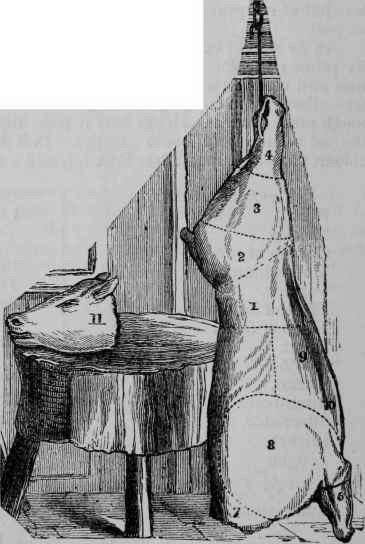
A calf is cut into the following joints:
1. Loin, best end.
2. Loin, chump end.
3. Fillet.
4. Hind knuckle.
5. Fore knuckle.
6. Neck, best end.
7. Neck, scrag end.
8. Bladebone.
9. Breast, best end.
10. Breast, brisket end.
11. Head, Fillet.
Breast, best end.
Loin and brisket, best and scrag ends. Neck, best end. Heart. Sweetbread.
For Pie. Inferior parts.
For Boiling, Knuckle. Part of shoulder.
Head.
Tongue and brains.
For Frying.
Cutlets from shoulder, etc, Liver.
For Stewing.
Breast, brisket end. Neck, scrag and best end. Sweetbread. Feet.
For Soup.
Inferior parts, as scrag, knuckle, etc. etc.
Continue to:


My Books

