


Canned Fruits And Vegetables. Part 2
Description
This section is from the book "The Bride's Cook Book", by Ralph P. Merritt. Also available from Amazon: Larousse Gastronomique.
Canned Fruits And Vegetables. Part 2
Measurements And Sizes Of Containers
EASUREMENTS and quantities of fruits and vegetables have been specified herein as 1 cup, 1/2 cup, etc., rather than 1 can, 1/2 can, etc. It might be well to say, however, that in preparing these recipes the generally recognized standard can of each particular variety has been used.
In most fruits, the No. 2 1/2 can is the customary size found on the grocers' shelves; likewise, for such vegetables as tomatoes, pumpkins, etc. Such varieties as string beans, peas, corn, etc., are ordinarily and commonly sold in what is known as the No. 2 can. With proper judgment there should be no difficulty in preparing these recipes regardless of the size of can used if instructions are followed as to the measurements specified in the recipes.
A word or two on the size of containers, however, may be of assistance to the housewife in purchasing canned products intelligently.
The most important containers in which DEL MONTE Canned Fruits are packed are No. 2 1/2, No. 2 and No. 1 Tall size cans.

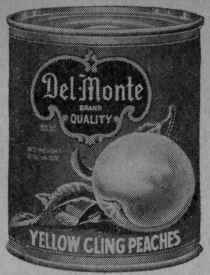
No. 2 1/2.
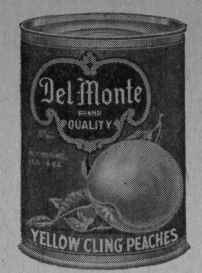
No. 2.
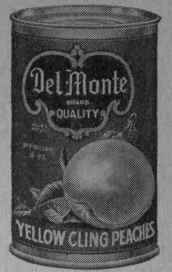
No. 1. Tall.
The fruit in such varieties as Apricots, Peaches, Pears and Plums is graded for size, the large fruit being packed in No. 2 1/2 cans, medium size fruit in No. 2, and fruit a trifle smaller in No. 1 Tall. This grading for size does not affect the quality in the slightest degree, for, as a matter of fact, the smaller and medium sized fruit, when selected for quality and fully tree-ripened, as DEL MONTE is packed, is just as delicious as the larger size fruit which goes into No. 2 1/2 cans.
The sizes of cans most customary in packing vegetables are the No. 2 1/2 and the No. 2 round cans. Asparagus is largely packed in square cans, the long spears in No. 2 1/2 and the short spears or tips in the No. 1 can. There are various styles of smaller containers used for such varieties as Tomato Sauce, Green Chile Peppers, Pimientos, etc., which the consumer soon becomes acquainted with and accustomed to, when purchasing such commodities.
The net contents will always be found specified on the labels. There is some variation, according to the variety of the product, but generally speaking the No. 2 1/2 round can, shown above, will contain from 27 to 30 ounces net; the No. 2, from 18 to 20 ounces and the No. 1 Tall about 15 ounces.
General Directions
Level measurements should be used in all the recipes contained herein. Each recipe is large enough to serve six moderate-sized portions.
The sirup from DEL MONTE Canned Fruits may be used as sauce for puddings, fritters and pancakes; it is delicious in fruit punches and lemonade; it may be substituted for the liquid in frostings and icings and will conserve a portion of the sugar; it may be frozen for a sherbet, or heated and poured over ice cream for additional flavor. It may also be used in place of vinegar in French salad dressing to be served on a fruit salad.
The liquid from DEL MONTE Canned Vegetables should never be thrown away. It may be used as the basis for soups, as the liquid in cream or white sauce, and it will give additional flavor to all meat and vegetable stews.
As this liquid is rich in mineral salts it should always be utilized. By its use with the vegetables or in one of the ways mentioned above the full food value of the vegetable is retained.
All bread crusts and stale pieces of bread should be saved, dried, and put through the meat chopper to make crumbs.
Stiffly beaten egg whites should be combined with other ingredients by folding in with a cutting motion and not a stirring motion. The air which has been beaten into the egg white is thus prevented from escaping.
Gelatin should be softened in a small amount of cold water before it is dissolved in boiling water. Use in the proportion of 1/2 cup of cold water for 1 envelope of gelatin.
White sauce or cream sauce should be smooth and creamy and free from lumps. To prepare it so that it meets all these requirements the following method has been found to be uniformly successful:
Melt the fat, or heat it, if a liquid fat is used. Remove from the fire and add the dry ingredients which consist of cornstarch or Victory flour, or any of the substitute flours, and the seasonings. When these are thoroughly mixed with the fat, add the cold liquid which may be milk or stock or water or a combination of two or of the three. Return to the fire and stir constantly until the boiling point is reached. Then if it is not to be used at once put in a double, boiler to keep hot until ready to serve. The following proportions may be used for the two grades of sauce:
Thin White Sauce (1 Cup).
1/2 tablespoon of fat.
1 tablespoon of Victory flour or cornstarch 1/2 teaspoon of salt 1/8 teaspoon of pepper.
1 cup of liquid.
Thick White Sauce (1 Cup).
1 tablespoon of fat.
2 tablespoons of Victory flour or cornstarch 1/2 teaspoon of salt.
1/8 teaspoon of pepper 1 cup of liquid.
Mayonnaise Salad Dressing.
Beat an egg yolk until it is light, add 1 tablespoon of lemon juice or vinegar, 1/4 teaspoon each of salt, mustard and paprika. Measure 1/2 cup of olive or salad oil and add a tablespoon at a time, beating constantly with a Dover egg beater. To increase the quantity a stiffly beaten egg white may be folded into the dressing just before it is served.
Any salad recipe calling for mayonnaise may be served with cooked salad dressing instead, if desired.
Tartar Sauce
Add 1 tablespoon each of chopped pimiento, chopped sweet pickle and chili sauce or catsup to mayonnaise.
French Dressing Measure 2 tablespoons of powdered sugar or corn sirup, 1/2 teaspoon of salt and 1/4 teaspoon of paprika into a bowl. Add 2 tablespoons of vinegar and stir or beat until thoroughly mixed. Then add 4 tablespoons of olive or salad oil and, if desired, 1 tablespoon of Worcestershire sauce. Mix thoroughly by stirring or beating. French dressing should always be prepared just before it is served.
Cheese Dressing
Add 2 tablespoons of Roquefort, or grated dairy cheese, to French dressing.
Continue to:


My Books

