


Chapter IX. Glaces And Pulled Flowers
Description
This section is from the book "Candy Cook Book", by Albert R. Mann. Also available from Amazon: Candy Cook Book.
Chapter IX. Glaces And Pulled Flowers
When sugar and water are boiled to a high temperature with an acid, as cream of tartar or lemon juice, part of the sugar is changed to glucose, and with careful treatment the syrup will remain clear and become very hard. When swung from a bunch of wires, fine threads fly off which look like spun glass. This is called spun sugar.
All kinds of nuts and fruits may be dipped in the syrup while it is hot. On a cold day they harden immediately, and remain dry a long time. In warm, damp weather they become sticky and unsatisfactory. They may be rolled in granulated sugar if the weather changes after they have been made.
Candy baskets and flowers require much experience for perfect results, but much pleasure and many attractive pieces may be attained by experimenting with a syrup boiled to the highest temperature it can reach without burning. It is wise to color the syrup before it boils, as stirring color paste into the mixture after it has cooked is liable to make it sugary.
Candy left over from spun sugar or flowers can be warmed by setting the saucepan on an asbestos mat on the range, and then can be poured out in a thin sheet on a warm tin, and broken in pieces when brittle.
Glace Nuts
2 cups sugar
1 cup boiling water
1/3 teaspoon cream of tartar
Put ingredients in a smooth saucepan, stir, place on range, and heat to boiling point. Wash off sugar which adheres to sides of saucepan with a butter brush dipped in cold water, and boil without stirring to 3100 F., or until syrup begins to discolor. Remove saucepan at once from fire, and place in a larger pan of cold water to instantly stop the boiling. Remove from cold water, and place in a saucepan of hot water. Take nuts separately on long pins or steel skewers, or with a small pair of tweezers, dip in syrup to cover, remove from syrup, and place on a tin sheet.
Glace Fruits For Glace Fruits, white grapes, strawberries, sections of oranges or mandarins, kumquats
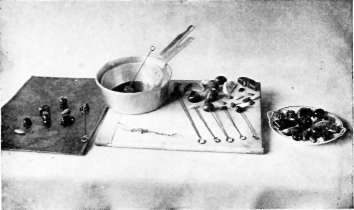
Glaceing Nuts and Fruits.
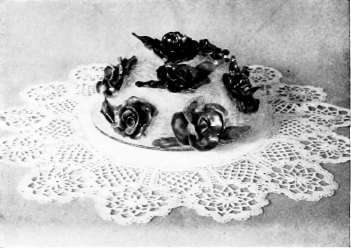
Candy Flowers on Bed of Spun Sugar candied cherries and other candied fruits, dates, and figs may be used.
Separate grapes from the clusters, leaving a short piece of stem on each grape.
Strawberries must be carefully dried, and the hulls left on.
Oranges and mandarins should have the skin carefully pulled off, not cut off, and should be separated into sections without breaking the membrane. Seeds may be removed through a tiny opening made on the inside edge of each piece of fruit.
Cherries are used whole. Candied pineapple and other candied fruits should be cut in pieces.
Dates and figs may be left whole or cut in pieces as desired. They may be stuffed before dipping.
Prepare syrup as for Glace Nuts, and dip fruit, one piece at a time, using a small pair of tweezers or a candy dipper, cover each piece completely with syrup, and then lay on a bright tin pan. Glace Fruits keep but a day, and should be attempted only in cold clear weather.
They are attractive when served in individual paper cases.
Marshmallows Glace
Brush marshmallows, and dip one at a time in syrup prepared as for Glace Nuts.
Glace Marzipan Cut or shape pieces of almond paste, prepared as for Almond Fruits, and dip pieces one at a time in syrup prepared as for Glace Nuts.
Jellies Glace Cut in cubes Mint Jelly, Apple Paste colored red and flavored with oil of clove, or Orange Pastilles . Dip in syrup prepared as for Glace Nuts.
Taffy Apples
6 small red apples
12 dates
¼cup nut meats
6 wooden skewers 1 cup brown sugar½cup water
Wipe and remove cores from apples, stone dates, chop both dates and nuts, mix, and use to fill cavities in apples. Cook sugar and water until brittle when tried in cold water. Put a skewer in each apple, dip apple in syrup; when covered, remove and cool.
Candy Flowers
2 cups sugar 1 cup water
Color paste
¼teaspoon cream of tartar
Put sugar and water in saucepan, add color paste as desired, - a small bit of red on the end of a toothpick will be sufficient to make pink roses, - cover, and boil three minutes. With a clean butter brush dipped in water wash all grains of sugar from sides of saucepan to avoid every tendency of the syrup to become granular. Add cream of tartar, put in thermometer if one is to be used, and boil without stirring to 3000 F., or until syrup will instantly crack and become like glass when a little is dropped from tip of spoon into cold water.
Another way to tell when syrup is done is to boil it until it begins to change color on one side of saucepan. Pour syrup on to a slightly oiled pan or white agate tray, and place tray on top of saucepan of boiling water, on the stove or in front of a gas oven. As soon as candy can be handled it should be pulled until glossy, keeping it always near the heat of a stove. Return candy to tray, allow it to become softened, detach a small portion, and shape into a closely curled rose petal. Place on a marble slab or tin sheet, away from the heat. Shape a second petal, and fold it around the first petal to form center of rose. Shape eight rose petals, adding them to the rose center one at a time as they are made, holding them in place at the base with a drop of melted candy. If a petal breaks it may be returned to the tray, softened, and molded again, though the gloss of worked-over candy is not so high. After the desired number of roses are made, the remainder of the candy may be colored dark green, and leaves and calyxes made.
Continue to:


My Books

