


526 - The Refrigerator Question
Description
This section is from the book "Cooking For Profit", by Jessup Whitehead. Also available from Amazon: Cooking for Profit.
526 - The Refrigerator Question
"Our first expressed lot of meat will arrive at noon; what is to be done with it to keep it? The cellar is as warm as out of doors and a good deal worse. New milk put down there at night sours before morning. A ham of the janitor's is covered with blue mold and is sticky to the touch, and salt and saltpetre on the shelf are trickling away in moisture, besides, the floor is muddy and the steps are broken down - are the other summer resorts around Uintah Lake no better fixed - Swibob's and Barnacle's and the Trulirural House?"
"Oh, that's all right; we are going to have a good refrigerator."
"What, right away, to be built now, in July?"
"Why, yes; as quick as the Fourth is over the men are ready to come. We waited for you to show them what is wanted. You chalk out the plan for an ice house and we can get plenty of ice to fill it."
The greater number of refrigerators put up for hotels and similar houses are failures through so few people understanding really what is needed until they have learned by dear experience. A refrigerator must be dry as well as cold, not steaming and with the clammy mois-ture of a cellar. It is often a good scheme where such a humid vault has nearly spoiled the meat in one day to take the meat out and hang it in the open air wrapped in a sheet and so keep it a week longer. Such a failure of a refrigerator as that, is a positive damage instead of benefit.
It should be conveniently located where it can be entered every few minutes, if necessary, without a long journey or a climbing of steps each time, if it is not, a great part of the benefits of having a perfect refrigerator are lost. And then it should be so constructed that the very frequent opening and shutting of the door will not have the effect of driving a warm blast through the mass of ice and unduly wasting it besides keeping the interior of the refrigerator always warm. To meet all requirements some houses have several refrigerators, each for a special use. There is the Tremont House at the other end of the avenue with perhaps a dozen, of all sizes, from the large storing rooms opened only once or twice a day to the handy little box holding cut meats close to the kitchen range.
Ice. | Ice. | ||
Fruits and Vegetables. | Milk and | Meats. | Beef. |
Plan of a jarge hotel's cold store rooms, front view
These are rooms of good size, say 6x10 and 6 feet high divided from each other; doors opening in front, with one large ice room above; all ventilated and drained and forming one great ice house with double walls filled with pulverized charcoal. This is built in a dry basement.
Out at the Bubbling Springs House they have a good ice house that is made to serve for many purposes, and it is built out of doors, just four steps from the kitchen door and therefore quite handy. It is good because it is well constructed with thick double walls well filled in and is roomy, perhaps 10 xio inside. It is a two-story building, the ice chamber being above; the ice blocks resting upon a frame of oak scantling. A zinc-covered floor leads off the water; the communication with the room below is by apertures along the sides of the floor. The roof is flat and covered deep with gravel. A spreading cedar tree partly protects it from the sun's rays. The defects of this ice house are these: It is but one room and it is the one refrigerator that must be used for everything. When the door is open the entire refrigerator is open and the hot summer air rushes up into the ice chamber - and the door is opened every few minutes through the day. Then it has no window, and the cook having excellent reasons for keeping his meat block within it and cutting the meats there must keep the door open while at work. It is more than probable that several hundreds pounds of meat and tons of ice are lost every summer through the general unhandiness and incompleteness of the refrigerating arrangements. A very bad break of this sort exists at the Balbriggan House, where the arrangements are generally very good, and a seemingly perfect square room refrigerator, with ice chamber above, as in the preceeding specimen, stands conveniently at one end of the kitchen. But when the carpenter work on this one was nearly finished, it happened that no sawdust could be ob- tained. As it was winter time there was no immediate need experienced; the refrigerator was finished up without either sawdust or charcoal being filled in the double wall and it remains so still, serving as a receptacle to melt away from two to three tons of ice each week with very little effect in cooling anything in the heated season.
These one-room refrigerators are, however, not the sort to have unless there can be more than one-or two of them in a house, each devoted to a different purpose.
The great International Cafe had to undergo two changes of proprietors and be partly remodeled within before it ever became the successful restaurant where elaborate little meals made up of the most diverse orders of viands could be obtained in a reasonably short time after the order was given. There being no room and no calculations made in the building for a convenient refrigerator a number of small ice boxes were first resorted to, set in all sorts of out of the way comers, one holding one thing and another something else, and it often happened that every one of them would have to be visited before the required articles were put together. A cook can perhaps travel twelve miles up and down stairs in twelve hours or sixteen miles through several halls and passages and back again in sixteen hours if he is required to do so, but he cannot cook many dinners at the same time.
Thus it was when the waiters would come rushing into the kitchen singing: "Hey; where's my order? Where's the cook?" The vegetable woman would answer: "The cook? he's gone a traveling down to the big ice box and when he gets there he'll go excavating through the ice to find something, but I guess he'll be back in half an hour."
When the source of trouble at length became fully understood at the International Cafe, something was pulled down and a refrigerator half as long as the kitchen was built along the wall opposite the range with so many compartments that it was hardly possible for an older to come that the material could not be found in one of these drawers. Since that time, instead of one cook and a losing business, the cafe has kept six or eight busy, and had a profitable career.
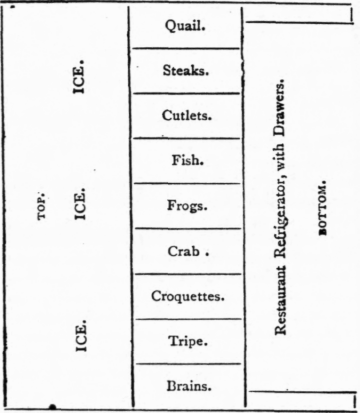
In all cases the construction ought to be planned in view of the fact that cold air descends and warm air rises In the specimen above marked out the provisions do not come in contact with the ice. The long box at top is filled with broken ice and has a zinc floor and the drawers slide in and are cooled from above through slits in the zinc so made that the water cannot drip through. Of course, like all ice boxes, the walls are double and the lid which is drawn up by means of a rope and pulley is the same.
The common square ice box filled with broken ice is also a good keeper of fish and similar kinds of provisions that are not injured by water. Put frogs' legs, lamb's fries, brook trout and a few such articles in muslin bags and bury them in the ice and they keep a long time and can be withdrawn easily when wanted; but, with that the usefulness of such a box ends, for meat is injured by being kept wet and by being washed after lying on ice, and pans set on top of ice are set in the wrong place, they should be beneath it.
In order that it may be clearly seen how much is required of a hotel refrigerator for all purposes let us look at the inventory of the contents of one for one day. There are:
Beef loins and roasts - always keeping a supply ahead to allow it to improve by keeping and become tender.
Cut meats and small meats - pans of steaks, chops and sliced ham, loin of veal, mutton, lamb, liver, etc., all carried in warm.
Brine keg for corned beef and tongues - it must stand in a cold place or the pickle will spoil in the course of three hot days ana all the newly added [meat with it.
Butter - one jar at least, for cooking, and probably the table butter likewise.
Lard - a can put in in a melted state.
Yeast - a jar just made and brought in warm.
Milk and cream - the cans warm from the dairy wagon and the milk pans from the kitchen for the milk to be poured in, all brought in to be made cold.
Fruit and melons - they will not be fit for the table unless cooled.
Ham and corned beef for supper - just out of the broiler and brought m smoking hot.
Roast meats left from dinner - brought in warm from the carving table also gravies and sauces, a dish of fish and plates of croquettes or other side dishes to be saved for another day.
Potatoes cooked to be ready to slice up for breakfast, dishes of peas and corn, half a pudding, some cooked codfish, a dozen bunches of celery, two or three pies.
These things and more brought in for this meal and soon taken out for the next cause the ice house door to be always in motion.
Some reader will say this thing or that shall not be put in, but managed some other way, but it is futile fighting against the inevitable. Perhaps a gallon of boiling hot mush will be stopped at the door and forbidden to be put in; but, will be left on the kitchen table and never be cold enough to slice and fry in the morning and so next night the refrigerator will catch it. That is what it is for. There should be a good one and large, if only one is to be built.
Continue to:


My Books

