


The London Exhibition. Part 4
Description
This section is from the book "Cooking For Profit", by Jessup Whitehead. Also available from Amazon: Cooking for Profit.
The London Exhibition. Part 4
Nectarine De Foie Gras A La Molesworth
By M. Alphonse Landry, of London.
A cylindrical mould resting on a layer of pounded rough ice is to be lined with a bright aspic jelly, the sides being decorated with cut truffles. Line the mould a second time with white sauce chaudfroid. When set, fill the mould lightly with foie gras mixed with truffles, both cut into smalt dice. To set the whole, fill up the mould with a good brown sauce chaudfroid, and finish with essence of truffles and aspic jelly of a good consistency. Let the mould remain in the ice until wanted, when dip it into hot water and turn out the contents on a dish. Fill the centre with truffles, and put croutons of aspic jelly round the base.
Foie-gras is liver-fat or fat liver; the French language generally puts the cart before the horse that way; but it specially means the livers of fat geese that come principally from Strasbourg where a great business is made of fattening geese for the sake of the livers.
Pate - de -foie - gras means two things, it is either paste of fat liver, with truffles in it, such as comes in jars from Strasbourg, or pie of fat livers - according to the accent on the word fate. The pie or pate made of a crust baked in a raised mould is oftenest lined inside with a coating of paste of foie gras and then filled with raw foies gras and seasonings covered and baked; to be eaten cold. M. Landry's dish above discribed is of cooked foies gras and truffles in jelly, in a border mould, and is a cold ornamental dish. See No. 860 of this book.
Ornamental Salt Blocks Or Stands
A cook having either of the foregoing named dishes in preparation and having to serve them entire at a dinner party will naturally look around for some means to elevate it into a conspicuosness corresponding to the recherche character of the composition and brings in little bits of scenery in the way of perhaps a castle carved in salt, with all sorts of ornamental details below while the top with its towers and battlements is so shaped that it holds the dish of timbales, already built up on a double crouton of bread fried brown, or other foundation; or some slender design of figures holding up a stand on which the ornamented "nectarine" is suitably displayed, bordered and brought in contrast of colors.
For salt blocks are carved in selected blocks of rock salt, which is semi-transparent and has a reddish color, and in the finest table salt caked together to the compactness and almost the hardness of stone. A "trophy of fillets of soles" might find a hand-some resting place on top of a rock of rock salt carved into
A Sea Cavern below; set upon glass with boats and other accessories of a cavern scene carved out of the pure white fine salt for contrast.
And when any cook or set of cooks have spent more time and pains on the ornamental stands than the edible dishes have cost them, it is but natural for them to carefully mention the stand or socle in every catalogue, and name their piece a bastion of truffles, or a "nectarine de foies gras sur socle" A man does not want people to fail to notice the stand or socle that he has been work-ing on of nights for two weeks before, merely because they are eager to sample the contents of the upper story.
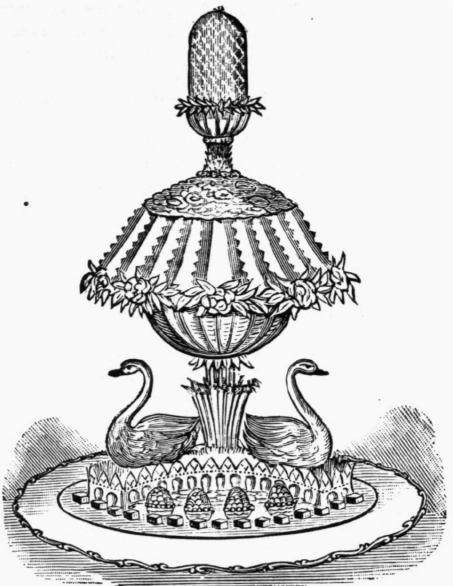
Fig. 1..
Dominicaines de Volaille.
By Mr. C. F. Corblet, of London.
Take a dozen tongue-shaped moulds as sold at the principal London coppersmith's. Butter them, line them with thin slices of raw filleted chicken flattened out, and then fill them up with a galantine farce by means of a forcing-bag.
The farce is made as follows: Take the remains of the flesh of the four chickens which have already yielded the fillets for lining the moulds. Put the chicken meat through the sausage machine, with twelve ounces of white of veal, and as much larding bacon; season with salt and spices; and pass through a sieve. Five large raw truffles and five ounces of tongue (red) cut in large short strips are to be mixed in. When the moulds are filled with this mixture, place them in a saute pan, and put them in a mild oven for half an hour. When cooked, turn them out on a napkin and let them get cold, trimming all the same shape.
Sauce them over with a white supreme chaudfroid sauce, with the exception of the thick end, which is to be sauced with a brown chaudfroid sauce. Now cut up in cocks'-comb shape two dozen pieces of very red tongue, and dip them in some aspic jelly half set. Dish the dominicaines up against a wooden stand covered over with mutton fat, spreading the fat with aspic jelly, so that the edible shall not come in contact with the fat. Alternate each dominicaine with one of the pieces of tongue, filling the space between the upper cup and the dominicaines with the cocks'-combs passed in aspic jelly. The upper cup should be filled up with a Russian salad, and at the foot of the stand on either side must be placed four artichoke bottoms filled up with a vegetable salad mixed with mayonnaise and decorated with aspic jelly.
A chaudfroid sauce is one that will set like jelly when cold.
The woodcut representation above gives an idea of the appearance of an ornamental piece - a cold entree that was awarded the prize of a gold medal at the French cooks' own exhibition in London. It is but justice to all concerned to say that these pictures are far less handsome than the reality. It is a piece that illustrates completely the explanations of the methods followed which are found in the salads and cold dishes addition to the American Pastry Cook, No. 802j. It was an original design, but employed:
1st. The wooden stand.
2nd. The wax flower and leaf ornaments.
3rd. The figures of swans made of mutton fat by casting in metal moulds.
There are shops in London where a great variety of moulds are kept for such purposes, usually they are of pewter and consist of two parts hinged together. Some are swans, some battle horses, some dragons, mermaids, deer, lions, dolphins, in short anything that would be suitable to place where the swans appear in the cut above can be bought or hired. The process is but to fill them with the whitest fat that can be obtained, in a melted state, open the moulds and take the figures out when cold.
Another sort of mould is also mentioned in the recipe; tongue-shaped moulds, and some London manufacturers advertise that they make any sort of mould to suit new designs and new fashions as they are required.
Another requirement is the wooden stand. The picture shows a wooden stand of two stories, like two cake stands set one upon another, except that these are two bowls or cups instead of flat stands. The whole of the stand is covered with mutton fat so that the wood is not perceivable but it looks like a stand of wax. The edible part is built up in the larger bowl and ornamented also with edibles. It was a symmetrical object and glistening with colored jellies and meats, and colored salads above the waxen wreath that borders the large bowl might well claim attention and admiration.
A few cooks will carry a small assortment of moulds along with them when they travel and if they remain for years in the same city may acquire a large collection; this is not the rule, however, and when a party is to be provided for on short notice the cook must either pick up some such ornamental objects as plaster images or toy birds and animals and make his own moulds in plaster of paris, or else make designs that do not require moulded figures, as can well be done according to the following showing.
The following is the outline of a piece that was put up with a large pattern of ornamentation, suitable for the purpose of these instructions. It is a wooden stand in the first place covered first with a smooth coating of stearine, then bordered and decorated with wax flowers and leaves. On top of the stand is a large platter containing a decorated galantine of turkey.
To obtain the wooden stands apply to a cabinet maker, and have them made of a size to hold the dishes you intend to use. There should be a rim of wooden hooping around the edge both to hold the dish and to give room for the ornaments. These stands will very likely cost about one dollar each. They may be of different sizes, the stems measuring from six to twelve inches in height.
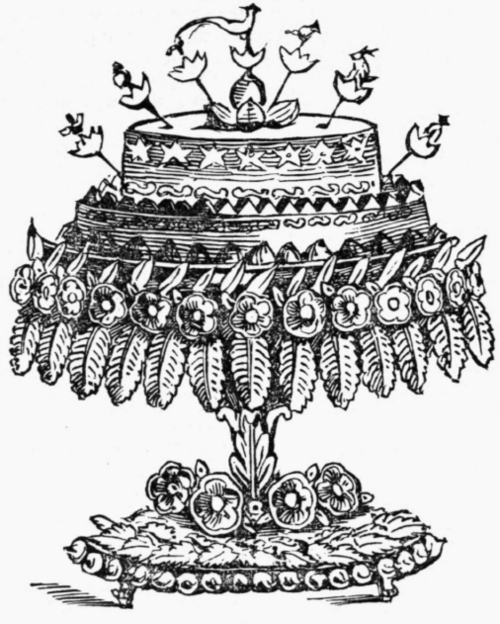
Fig. 2. Galantine de Dinde sur Socle.
(Boned Turkey in Jelly on Wax Stand, Magnolia Pattern).
By Fessup Whitehead.
Served at a terrapin supper given by Mrs. Robt. J. Lowry (Miss Markham), at Atlanta, Ga.
To cover the stand, melt either some white wax, or parrafine, or stearine, or mutton tallow, or a mixture of wax and tallow. White wax can be and is used in that way and is cleanly, but it is expensive and hard to make a smooth surface with, on account of the high degree of heat required to keep it in a melted state. Mutton fat mixed with wax is a good material, but better still is the same stearine that candles are made of; it does not grease the fingers and has no smell. Wax costs from fifty cents to a dollar a pound while candles can be bougt at eight pounds for a dollar. Melt in a tin pan and pour it over the stand with a spoon. When the wood is everywhere covered hold the stand in front of a fire, turning it about while the surplus fat drips off and leaves a smooth, even surface; then, when the stand has become cold and white take a hot knife and smooth off the edges and ridges that remain.
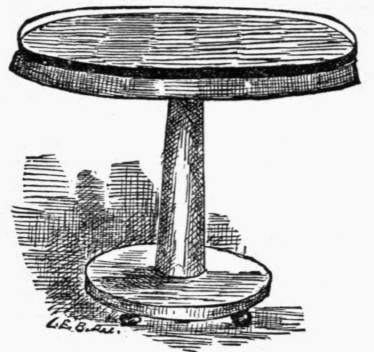
Fig. 3. Tree Designs for Game Pieces.
But if the design is to be a tree select a natural bousrh from a tree or bush, something that branches handsomely like a deer's horns with room in the forks to place a piece of wood as large as a plate or dish. Set the butt of it in a wooden bottom like that shown for the other kind of stand and fasten the upper shelf in the forks where the boar's head is to be, then proceed to coat over the entire stand and branches with stear-ine as in the other case. Coral branches and sea-weed designs can be prepared in a similar manner. When the stand is thus for prepared proceed to cover it with wax leaves, fruit, berries, flowers or any ornamental shapes that may suit the subject; the tree stand may be decorated with leaves and fruit on every twig.
Continue to:


My Books

