


552 - Cutting Up A Ham
Description
This section is from the book "Cooking For Profit", by Jessup Whitehead. Also available from Amazon: Cooking for Profit.
552 - Cutting Up A Ham
One of the most serious calamities that ever Details Mary Jane is the sending her a whole ham to cut up, all by herself: it is a calamity to the ham, too, when she has whittled it and hacked and torn in with her little case-knife that she tries to sharpen on the edge of the stove. Her reliance and the reliance of most private families is upon the butcher generally to slice the ham before sending it, but in that case good ham is never as good as it might be because it is cut too thick and being sawed through the bone from one end to the other many of the slices are of such a sort that a little of it goes a long way. We have in our kitchen a meat block, a meat saw and a small cleaver, besides good knives. These things are indispensable both for economy and good quality of the dishes we cook. Without them our choice ham that costs 15 cents a pound gross, and when the bone and rind is counted out, costs somewhere between 20 and 25 cents, might all have to be whittled away in shreds and shavings without a respectable slice among them. The best and most saving method of dealing with a ham is as follows:
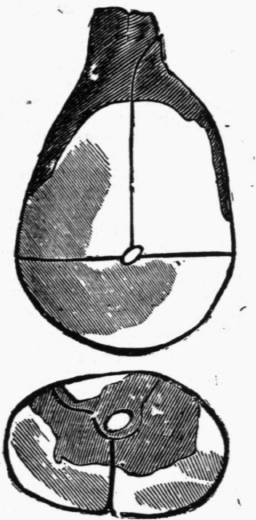
First, saw off the butt end of the ham as shown above, taking the projecting point of bone that is easily found for a guide where to cut. The lower wood-cut shows the inside of the butt where it has been cut and the black lines show where the knife must go to separate the meat on both sides from the irregular shaped bone. There are then two pieces of ham, all meat, ready to be cut in slices, the thinner the better, with a sharp knife. Then cut down the large or mam portion as the line shows, from the shank to the bottom. There is a bone that guides the knife down that mark. All the piece on the right is solid meat; the best part of the ham, and makes the handsomest slices. The other side can be sliced part way or be used for boiled ham.
Continue to:


My Books

