


Fuels And Stoves. Part 5
Description
This section is from the book "Lessons In Cooking Through Preparation Of Meals", by Eva Robeeta Robinson. Also available from Amazon: Lessons in Cooking Through Preparation of Meals.
Fuels And Stoves. Part 5
Electric Meter
The electric meter like the gas meter is composed of dials, but the unit of measure is the "watt" or "watt-hour." One thousand watts is a kilo-watt. Bills are usually measured in kilowatts.
The method of reading is exactly the same as the gas meter - taking always the lower figure next to each hand, being careful to note that the hands on the alternate dials move in opposite directions.
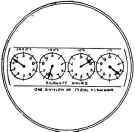
Meter A
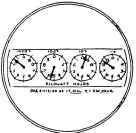
Meter B
In reading Meter A, dial | I reads ............................. | 3 kilowatts |
In reading Meter A, dial | II reads .............................. | 80 kilowatts |
In reading Meter A, dial | III reads ............................ | 500 kilowatts |
In reading Meter A, dial | IV reads ............................. | 1,000 kilowatts |
June 1st, the total is ...................................................... | 1,583 kilowatts | |
In reading Meter B, dial | I reads ............................. | 8 kilowatts |
In reading Meter B, dial | II reads .............................. | 90 kilowatts |
In reading Meter B, dial | III reads ............................. | 500 kilowatts |
In reading Meter B, dial | IV reads ............................ | 1,000 kilowatts |
July 1st, the total reading is ............................................ | 1,598 kilowatts | |
June 1st, the total reading is ............................................. | 1,583 kilowatts | |
Electricity used in June ............................................ | 15 kilowatts | |
At an average cost of 10 cents per kilowatt hour the bill for electricity for June will be $1.50.
The Constant
Some meters have upon them the word "constant" followed by a figure. In such case the reading of the leter must be multiplied by this figure in order to get the correct total. For example if the constant is 1/2 then the reading must be multiplied by 1/2. Hence in the above reading if there had been a constant of 1/2 the total reading would be 15 times 1/2 or 7 1/2 kilowatt hours.
Relative Cost Of Fuels
A number of experiments have been made to find the relative cost of fuels in cooking, but they would not be applicable to all home conditions, as many times the heat from the fuel is required for other purposes. But the actual cost of cooking the same dinner, including soupstock, with coal, gas and kerosene, was found from experiments made at the University of Chicago, to be as follows:- coal, .0605, gas $.0334, and kerosene $.0353. The price of coal gas $7.75 a ton, gas 85 cents per 1,000 feet, kerosene 12 cents a gallon. Compared as to quantities, one ton of hard coal was equivalent to 5,000 cubic feet of gas, and 1,000 eet of gas to 8 gallons of kerosene.
Gasoline has nearly the same fuel value as kerosene. A rd of dry hard wood has about the fuel value of half a ton of coal.
Acetylene gas is sometimes used for cooking; it has about five times the fuel value of ordinary illuminating gas, and costs about $1.25 per 100 cubic feet.
Continue to:


My Books

