


Lessons In Cooking. Part XI. Canning Of Vegetables
Description
This section is from the book "Lessons In Cooking Through Preparation Of Meals", by Eva Robeeta Robinson. Also available from Amazon: Lessons in Cooking Through Preparation of Meals.
Lessons In Cooking. Part XI. Canning Of Vegetables
In canning vegetables the same principal for preservation must be employed as for fruit - that of thorough sterilization. As we cannot use either a strong sugar or acid solution to aid preservation, we are reduced to one method of sterilization - the employment of heat. Consequently the greatest caution and care must be taken to insure good results. Even then there may be some failures because the temperature used cannot, under ordinary circumstances, be raised above that of boiling or 2I2°F, and the spores of some bacteria are supposed to resist any temperature below 240°F. These developing later into active bacteria cause the vegetables to spoil.
To prevent this a greater degree of success may be obtained by dividing the time of cooking into three parts, allowing. 24 hours or more to elapse between each period of cooking. This will give the spores time to develop into bacteria, which are subsequently killed by the boiling temperature. The third cooking should render the entire contents of the jar sterile.
The commercial canners of vegetables heat the cans by means of steam under pressure and so obtain a higher temperature than 212°F. As it is not possible to do this in the home, the intermittent method of sterilization should be used rather than long cooking for 3 to 5 h. By the intermittent method the full flavor and color are retained, whereas long, cooking has an unfavorable effect.
Vegetables for canning must be freshly gathered, preferably early in the morning while the dew is still on them.
All green vegetables, such as peas, beans, corn, should be taken in the early stage before they lose the "sweet taste"- that is before the sugar is changed to starch.
Utensils
Where canning of vegetables is done in large quantities canners may be used, but the directions given here are for the use of the utensils found in the average home.
1. A wash boiler having a tight cover or a large steamer of the square type with doors.
2. A rack or trivet on which to set the cans if a boiler is used. This may be made of narrow strips of wood, or preferably of galvanized iron wire netting, 1/2 inch mesh, cut to fit the bottom of the boiler.
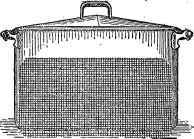
Sterilizer - Wash Boiler With Wire Mesh Bottom
3. The glass jars having glass covers and spring tops are the best to use. The screw top jars with covers which have a porcelain lining are not safe to use, for any vegetables except tomatoes. Use pint or quarts, according to the size of the family. Always use new rubber rings of the best quality.
Canned Peas
Select young, tender peas, shell and wash in cold water. Scald with boiling water, drain immediately and pack into jars, shaking down well. Fill to overflowing with water, having 1 t of salt to the quart. Adjust covers, set on the rack in the boiler and steam for an hour on three successive days, as directed for canned corn. If cans are not full, fill to overflowing with boiling water, being careful not to lay the covers down, as they may gather yeast spores. Be sure to test the cans for sterilization as described.
Lima, Kidney or Other Shell Beans may be canned according to the process given for peas. If desired the preliminary scalding may be omitted, but this allows more of the vegetable to be packed in the can.
Canned Asparagus
Have the asparagus cut fresh and use only the tender stalks or portions of stalks. Wash and drain, cover with boiling water and cook 10 m. Drain, and when cool enough to handle, arrange neatly in jars with the heads up, using wide mouthed jars. Add 1/2 t salt to each pint jar, fill to overflowing with boiling water, put on the covers loosely, set in the boiler and cool in the kettle.
Canned Tomatoes. I. Whole Tomatoes
Select tomatoes that are small, even sized and solid. Scald and peel, being careful to remove the stem end. Arrange in jars, fill with cooled boiled water, cover loosely, set in boiler, surrounded in water as in preceding cases, and boil 1/2 h. If necessary fill each can to overflowing with boiling water and fasten the lids. Imperfect tomatoes can be sliced, cooked and used instead of the boiled water to fill the jars.
II. Stewed Tomatoes
Prepare tomatoes as in the preceding directions, cut into halves or quarters, cook in porcelain lined vessel for about 30 m. Sterilize the jars and fill with the boiling tomatoes to overflowing. Adjust the lids, screwing tight or sealing.
Canned Corn And Tomatoes
Prepare the corn according to directions given in Process II, thus using only the pulp. Add to tomatoes, using equal portions of each and follow directions given for Stewed Tomatoes.
Canned Beets
Select small young beets. Wash and boil for 30 m. Remove the skins and pack carefully into jars. Fill the jars with vinegar and water, which has been boiled and cooled, using 1 part vinegar to 2 parts water. Adjust the covers, set in boiler, surround with water, as in the preceding directions, and boil for 3/4 h. Tighten the covers and cool in the boiler.
Carrots and turnips may be canned after this rule. Wash and pare, then boil for 30 m. and proceed as above, using plain boiled water instead of vinegar and water.
Continue to:


My Books

