


Baked And Roast Rabbit
Description
This section is from the book "Choice Dishes At Small Cost", by A. G. Payne. See also: Larousse Gastronomique.
Baked And Roast Rabbit
The drawback to rabbit is, that the flesh, as a rule, is somewhat dry. In roasting or baking a rabbit, therefore, cover the rabbit, after it is skinned, drawn, and soaked in cold water for an hour, with thin slices of bacon. This will keep the rabbit well basted, and also the bacon itself can be eaten with the rabbit after-wards. The bacon can be removed near the finish, and the rabbit browned. Make a little gravy in the dripping-pan (see No. 3), and serve with the rabbit. Put the bacon round it, and also serve some plain boiled potatoes with it. Time to roast or bake, from forty minutes to one hour, according to size.
N.B. - Roast rabbit can be stuffed with veal stuffing (see Veal), sage-and-onion stuffing (see Sage), or liver force-meat (see Liver).
Boiled Rabbit
Have the rabbit skinned, drawn, and soaked, as before, for an hour in cold water. Boil (see No. 1): for about half an hour for a young rabbit, up to one hour for a large one. Serve with onion sauce (see Onion Sauce), or parsley-and-butter sauce. Babbits are best boiled in a stock-pot. (See No. 10).
How To Carve Boiled Rabbit
First, separate the legs and shoulders; then cut the back across into two parts. This may readily be accomplished by inserting the knife in the joint, and raising up the back with the fork. As in the case of the hare, the back of the rabbit is best worth eating.
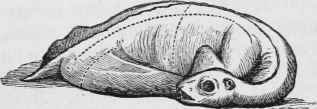
RABBIT, BOILED, TO CARVE.
Continue to:


My Books

