


How To Carve Goose Roast
Description
This section is from the book "Choice Dishes At Small Cost", by A. G. Payne. See also: Larousse Gastronomique.
How To Carve Goose Roast
Begin by turning the neck end of the goose towards you, and cutting the whole breast in long slices, from one wing to another (see the lines A, b). To take off the leg, insert the fork in the small end of the bone, pressing it to the body, put the knife in at A, turn the leg back, and, if the bird be young, it will easily come away; if old, we will not answer for it. To take off the wing, insert the fork in the small end of the pinion, and press it close to the body; put the knife in at b, and divide the joint. When the leg and wing are off one side, attack those on the other; but, except when the company is very large, it is seldom necessary to cut up the whole goose.
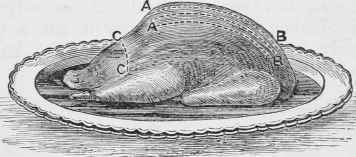
GOOSE, ROAST, TO CARVE.
The back and lower side bones, as well as the two side bones by the wing, may be cut off; but the best pieces of a goose are the breast, and the thighs, after being separated from the drumstick. Serve a little of the seasoning from the inside, by making a circular slice in the apron at c.
Roast Goose
A roast goose is generally filled with sage-and-onion stuffing (see Sage-and-Onion). The way in which this is made must depend upon the taste of those who have to eat it. If a strong flavour of onion is liked, the onions should be chopped raw. If this is not the case, they should be boiled in one, two, or three waters, and mixed with a smaller or larger proportion of bread crumbs. It should be remembered, when bread crumbs are used, room should be allowed for swelling. Truss the goose firmly, tie the openings securely, put it clown to a clear, brisk fire, and baste it plentifully until clone enough (see No. 3). A goose is both unwholesome and unpalatable if insufficiently cooked. Take it up, remove the skewers and fastenings, pour a little gravy round it, and send some good gravy (see Gravy), and apple sauce to table with it. Time, from an hour to an hour and a half for a middling-sized goose.
Continue to:


My Books

