


Loin Of Roast Mutton
Description
This section is from the book "Choice Dishes At Small Cost", by A. G. Payne. See also: Larousse Gastronomique.
Loin Of Roast Mutton
(See No. 3.) - This joint is often a very extravagant one, owing to the exceedingly wasteful palates of the persons who dine off it. By far the best and most economical way to treat a loin of mutton is to bone it. Cut up the upper part for cutlets (see Cutlets); make a small Irish stew of the ends. (See Irish Stew.) Stew the fillet, or cook the fillet whole as a cutlet - a most delicious dish. Make the bones into stock, and the fat into a pudding, or run it down into dripping.
Another way is to bone (see No. 22) the loin, fill it with veal stuffing (see Veal Stuffing), roll it up, tie it securely round with string, and bake it in the oven; serve with some rich browm gravy. ■ A loin of mutton boned, rolled, and stuffed, is very nice cold.
Mutton Pie
Cold mutton, especially when underdone, makes a very nice pie. Cut the mutton in slices, use the bone to make Stock No. 3. Put the meat in a pie-dish, and lay it in alternate layers with some potatoes sliced thin. Season with a piece of onion as big as the top of the thumb chopped fine, a pinch of mixed sweet herbs, a little chopped parsley (about a teaspoonful), some pepper and salt; cover with some good stock, make an ordinary crust, cover, and bake. If the stock is good, and sets into a jelly, this pie is very nice cold for breakfast or lunch. A sheep's kidney sliced and added is a great improvement.
Roast Mutton
The best joints for roasting are the leg, the haunch, the saddle, the loin, the shoulder, and sometimes the neck. Mutton should not be roasted too fresh, especially the haunch and leg. The former is often covered over with a flour-and-water paste during the earlier period of roasting. When nearly done the paste is removed, the joint brought nearer the fire, basted with butter, and quickly browned of a mahogany colour. Red currant jelly should be served with haunch of mutton and saddle of mutton.
The leg of mutton is really part of the haunch, and is sometimes carved haunch-fashion, i.e., parallel with the bone.
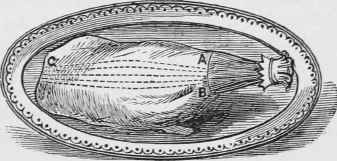
HAUNCH OF MUTTON, TO CARVE.
In carving a haunch of mutton make an in-cision from A B with the point of the knife, holding the knife rather upright, then cut slices down the joint from a to c. After a few slices are cut, the gravy will settle in the meat, and a little can be poured over each slice with a spoon. Take care in carving the haunch not to let the gravy run out of the joint into the dish.
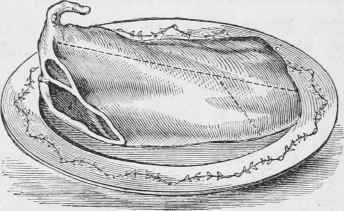
SADDLE OF MUTTON.
In carving a saddle, cut slices longways out of the back, putting the knife into the meat near the tail, and bringing it down parallel with the spine. The latter part of the slice will contain plenty of fat.
In small dinner-parties where the joints are not carved on the table, a leg of mutton cut haunch-fashion, or a loin cut saddle-fashion, will often serve for those larger joints.
Full directions for roasting will be found in No. 3. Always have a little fresh gravy hot to be poured over the joint some little time after it has been carved - in time for the second help.
Almost any kind of vegetables may be served "with roast mutton.
Onion sauce (see Onion Sauce) should be served with roast shoulder of mutton, and is often sent in with a leg. A saddle is generally esteemed the prime joint. At one of the most popular restaurants in London, chiefly noted for its joints, a dozen saddles are cut up to one haunch.
Continue to:


My Books

