


No. 29. Hints On Dish Ornamenting
Description
This section is from the book "Choice Dishes At Small Cost", by A. G. Payne. See also: Larousse Gastronomique.
No. 29. Hints On Dish Ornamenting
It is a very great mistake to think if a dish looks very pretty that therefore it is necessarily an expensive one. I fear few English cooks understand sufficiently the importance of appearances. For instance: fried bacon, clear and crisp, in a clean hot dish, does not cost more than dirty-looking fried bacon in a dish with the fat in it half-cold, with black pieces in it, while the edge of the dish shows dirty, greasy thumb-marks.
Greens are no cheaper when served in green water with a nasty smell, with perhaps one or two caterpillars.
Toast - a nice brown, all over alike - is no dearer than toast that consists of a piece of bread with a black patch in the middle, and white edges.
I fear that to teach some persons devoid of taste how to make dishes look nice and pretty, would be as hopeless as to talk of music to one who cannot distinguish the difference between "God Save the Queen" and an Irish jig. Yet there are many - let us hope the majority - who have an eye for colour, etc., to whom hints may be valuable.
First, Soups
If the soup be clear, if you have vegetables in it, try and get a few that will make a pretty contrast in way of colour - such as little squares of red carrot, white turnip, and a few green peas. Where there is a garden this is easily done. Again, in cutting the carrot reserve the bright red edge to go in the soup, the pale yellow inside will do for the stock.
In the case of thick soups, try and obtain a rich dark brown. For this, brown thickening is essential. Also take care the grease is all removed, and if you have used black pepper for the soup to flavour it, take care in pouring off the soup you don't pour in the little black dregs at the bottom, which will settle in the soup plates like grit. In the case of white soups, remember the whiter the better, and that when we cannot afford cream we must have more milk, and that the stock must be reduced, the milk boiled separately, in order to get a nice white colour. So again with green-pea soup. Let it be green. A little trouble and spinach is all that is reqiiired.
Next, with regard to fish. Fried fish should be ornamented with fried parsley. If you have the fat properly managed - that is, deep and hot - fried parsley only takes a few seconds to cook, but after frying should be placed for a minute in the oven to drain and get crisp. Place a few pieces round the fish on the paper in the dish in which they are placed. Thick white cartridge paper is best, and can be cut to fit. the dish by folding the paper into four, placing the centre of the paper when open - i.e., the point when folded - in the centre of the dish; then press round the inner rim of the dish so as to mark the paper the right size. Next: cut this neatly round without unfolding the paper; then cut a little crimped edge. When you open the paper, each quarter must be exactly the same size, as they were all cut at the same time.
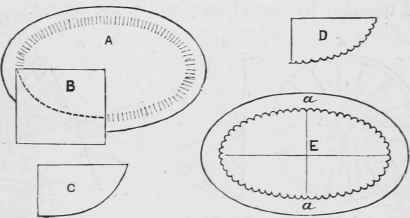
A, the dish; b, a sheet of white paper folded into four. The dotted line, the mark made by pressing the paper down into the inner rim of the dish; c, the paper cut plain; d, with a crimped border; e, the cut paper opened flat, and put into a dish; a, for the fish.
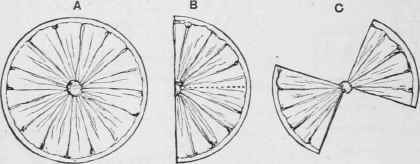
A slice of lemon will make a pretty garnish for fish. Cut a thin slice of lemon, and cut it in half; then cut each half through the middle of the yellow rim, and open the two pieces, which will be held together by the white piece in the centre.
Cot Lemon.
A, a thin slice of lemon; b, half a slice; c, the half slice cut through the dotted line, and opened for garnishing fish, jellies, etc.
Cut lemon is also a nice ornament for boiled fish. Suppose the boiled fish is a flat one, such as a sole boiled whole, or a plaice, or brill, or turbot; place the fish, with the white side uppermost, on a white napkin - folded round a fish-drainer is best - on a good-sized dish.
Have ready a little dry chopped parsley. Take a, knife, and take a little parsley up on the end of the blade, and then knock the blade gently, so as to let the chopped parsley fall from a little height. Next, if possible, have a little red lobster coral, and act the same with it. The white fish will now be sprinkled over with little red and green specks. Cut lemon and fresh green parsley (not fried) may be placed alternately round. A small red crayfish placed in each corner makes a very handsome garnish, but these are not always easily to be obtained.
If you have no red lobster coral, which is often the case, make a few bread crumbs, which can be done in a second by rubbing a piece of stale bread on the wire sieve. A saltspoonful will be plenty.
Throw them on a plate or saucer with a few drops of cochineal, and shake them in the saucer. This will turn the bread crumbs a bright red directly. These do as well as coral, and a bottle of cochineal (sixpence) with care will last a year. Then take these red crumbs up on a knife, and flip it as before.
The fish will generally look best if you let the crumbs and chopped parsley fall naturally.
Another method of getting "little red specks" for garnishing, is to cut up a red chili. You will generally find one or two in the bottle of pickles, or you can buy them pickled by themselves. Persons who are fond of hot curries, etc., would do well to have a bottle of chilies in the house. When cut up they are a great improvement to hash - especially for those who like "heat".
Suppose we have that cheap and nice dish, boiled sole filleted. We have the little white fillets of sole rolled up, standing in a dish, say, a vegetable dish, and the thick white sauce, made from thickening the water in which we boiled the bones and fins. (See Sole).
Continue to:


My Books

