


Roast Duck
Description
This section is from the book "Choice Dishes At Small Cost", by A. G. Payne. See also: Larousse Gastronomique.
Roast Duck
This universal favourite requires no praise. Without entering into the question of the best duck, we say at once, take a young farmyard duck fattened at liberty, but cleansed by being shut up two or three days and fed on barley-meal and water. Two small young ducks make a better dish than a large, handsome, hard-fleshed drake, which, as a rule, is best fit for a stew. If the poulterer does not prepare the duck, it must be plucked, singed, and emptied; the feet scalded, skinned, and twisted round on the back of the bird; head, neck, and pinions cut off, the latter at the first joint, and all skewered firmly to give the breast a nice plump appearance. For the stuffing, take half a pound of onions, a teaspoonful of powdered sage, three tablespoonfuls of breadcrumbs, the liver of duck parboiled and minced with pepper, salt, and cayenne. (See Sage-and-Onion Stuffing.) Cut the onions very fine after parboiling them, and add the bread-crumbs, minced liver, sage, pepper and salt to taste; mix, and put it inside the duck. This quantity is for one duck; more onion and sage may be added, but we recommend the above as a delicate compound not likely to disagree with the stomach. Let the duck be hung a day or two, according to the weather, to make the flesh tender. Roast before a brisk clear fire (see No. 3), baste often, and dredge with flour to make the bird look frothy. Serve with a good brown gravy (see Gravy) served separate, in a tureen. A very little may be poured over the bird, and apple sauce (see Apple Sauce) in another tureen. Time: ducks, three-quarters of an hour to an hour; ducklings, twenty-five to thirty-five minutes. Probable cost, 3s. to 4s. each. Sufficient, two ducks for seven or eight persons.
How To Carve Roast Duck
A young duckling should be carved in the same way as a fowl, the leg and wing being taken off, first of all, on either side. (See Fowl, Roast, To Carve.) A full-sized bird should be carved like a goose. First cut slices from the breast, in the direction indicated in the figure by the clotted lines from A to B. The first slices are to be cut close to the wing; then proceed upwards towards the breast-bone. The legs and wings may afterwards be attacked. An opening is to be made, shown by the dotted line c, to get at the stuffing.
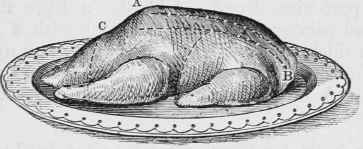
ROAST DUCK.
Continue to:


My Books

