


Fish Kettle (Poissonniere)
Description
This section is from the book "The Epicurean", by Charles Ranhofer. Also available from Amazon: The Epicurean, a Complete Treatise of Analytical and Practical Studies on the Culinary Art.
Fish Kettle (Poissonniere)
Fig. 135 represents a fish kettle, these are either of copper or tin. The fish is placed on a metal sheet perforated with half inch holes, this has handles on both sides, it is put down into the bottom of the fish kettle and lifted again when the fish is cooked, thus avoiding the breaking of it.
Fig. 136 represents oblong shaped, deep baking pans having handles on each end. These pans are furnished with a perforated metal grate. Their raised edge cover (Fig. 136), can when turned upside down, also serve for a deep pan suitable for cooking flat fishes, fricaudeaux, sweet-breads, etc.
Fig. 137 represents a series of six small timbales with flat bottoms ranging from No. 1 to No. 6. These timbales as shown in the figures are just half their actual size.
Fig. 138 shows a series of convex molds for mousselines, No. 1 to No. 6. These molds like the flat bottomed ones are drawn half their proper size. They are to be placed on metal sheets perforated according to the size of the molds, supported by half inch high feet.

Fig. 135.

Fig 136.

Fig. 137.
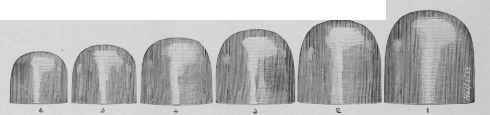
Fig. 138.

Fig. 139.
Fig. 139 are various border molds, the first has a concave bottom and is specially used for dressing entrees of chicken and game fillets, quenelles, etc. The second is an oval mold with a flat bottom useful for large releve borders. The third is a round bomb shaped mold with Baring sides, used for molding rice or forcemeat borders. The fourth is a plain bottom mold and the fifth is of an octagon shape with a flat bottom.
Continue to:


My Books

