


Kitchen Utensils
Description
This section is from the book "The Epicurean", by Charles Ranhofer. Also available from Amazon: The Epicurean, a Complete Treatise of Analytical and Practical Studies on the Culinary Art.
Kitchen Utensils
Copper Basin For Cooking Sugar With Thermometer (Bassine Pour Cuire Le Sucre Au Thermometre)
Fig. 166 is a small copper basin with a tin cover having a hole in its top sufficiently large to allow the thermometer to be inserted. The steam that condenses on the side of the cover is continually cleansing the sides of the basin, so that when the sugar is well stirred there is no necessity to watch it, only see that it continues to cook to the desired heat.
Syrup Gauge (Pese Sirop)
After a person has the habit of cooking sugar he rarely requires a syrup gauge; the degree of cooking can be judged by simply touching it with the fingers, but those who have not yet attained this proficiency need always use the syrup gauge. Place in a bottle and then plunge into the syrup this glass instrument which rises or falls according to the thickness or thinness of the liquid thereby giving the exact degree of its cooking by the numbers marked on it (Fig. 167).
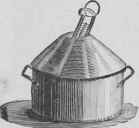
Fig. 166.

Fig. 167.
Column Box (Boite A Colonnes)
Fig. 168 represents a column box. These tubes are for removing fanciful cuts of truffles, tongues, egg white, etc. The medium sized ones can be utilized for stoning Spanish olives; they are also used for coring apples and for rolling paper frills, for cutting vegetables, jardiniere, macedoine or Chartreuse, for bread croutons, etc.
Lemon Squeezer (Presse Citron)
Fig. 169 represents a lemon-squeezer. This kind is in common use and is used for squeezing lemons for ices, jellies, etc.

Fig, 168.

Fig. 169.
Strainer (Chinese), And Mixing Pot For Thickening (Passoire Chinois Et Melangeur Pour Liaisons)
Fig. 170 represents a sauce strainer commonly called Chinese; they are made of tin or metallic tammy. It is necessary to have several sizes more or less fine ; they are either pointed or flat as shown in the design and are in constant use for sauces and gravies.
Fig. 171 is a kind of pot containing a mixer. This is to stir egg-yolks and cream together for pouring it into sauces and ragouts for thickening; this is found especially handy for Hollandaise sauce.

Fig. 170. Fig. 171.
Gridiron (Gril)
Fig. 172 represents a thin wire double gridiron; it is useful for toasting bread, crackers, broiling oysters, tomatoes, and sliced potatoes. Stronger and thicker gridirons are used for meats and fish, having just sufficient room to hold the articles.

Fig. 172.
Meat Chopper (Pour Hacher Les Viandes)
Fig. 173 is a perpendicular machine used for chopping meats; these are excellent, and are well adapted for making Salisbury steaks or Hamburg steaks. They have this advantage that they cut the meats without cutting the nerves,'so that the meat comes to the top lightly chopped and nerveless.

Fig. 173.
Continue to:


My Books

