


Puddings
Description
This section is from the book "Hand-Book Of Practical Cookery", by Pierre Blot. Also available from Amazon: Hand-Book of Practical Cookery, for Ladies and Professional Cooks.
Puddings
Puddings are made of several materials and in a hundred different ways. Some are cooked by boiling, others are baked, and some are both boiled and baked. Puddings for inhabitants of cities ought to be made as light as possible. For persons working outside and at manual labor, it does not matter, because their food passes through the system in a short time. It is very well known that the poorer class of Americans eat too much pudding and pie. Many do it for economy, others for convenience. The former are mistaken, and the after are blamable. Puddings and pies cost more in the end than meat properly and carefully prepared. We do not mean to do away with them entirely, but we advise every one to do with puddings as with every thing else, "use, but do not abuse." "Pies, cakes, and sweetmeats, are universally known to be poisoning to children, and the mothers who give them are conscious that they are purchasing the momentary smile of satisfaction at the risk of after-sickness, and perhaps of incurable disease." - Peter Parley.
The above needs no commentary; we only recommend it to the consideration of young mothers.
For Convenience
We have taken the trouble to put questions about it to over three hundred mothers, wives of mechanics or of employes at a comparatively small salary, and we are sorry to say, that more than ninety per cent, gave us about the same answer - they make and cook cakes in one day, enough to feed the whole family for three days, to save the trouble of cooking every day. We cannot see where the trouble can be for a good wife and mother to prepare her husband and children's dinner.
Pudding-eating is an English custom ; but, before following a custom of another country, people ought to consider if that custom or fashion (whatever it is) has not been introduced into that country by necessity, which is the case of pudding-eating in England and in some parts of Holland.
In England, where the fog is nearly perpetual, the stomach requires to be filled with something heavy, something that will stay there till the next meal, and very often longer than that.
It is well known that in England farm hands, or other persons working in the open air, eat six times a day, and have pudding at least three times; they drink home-brewed beer, which is very heavy, and very rich also. Let any one here, in this pure, clear atmosphere, eat six times a day, have pudding three times, with a pint of home-brewed beer every time, and see how he will feel in the evening. We beg all, who may doubt our observations, to try the experiment.
Pastry in general, no matter how light it may be made, lies heavier on the stomach than any other food, and is very difficult of digestion. There are thousands of persons that have never had any indigestion but of pastry. Children like pastry very much ; this is easily understood; as their young stomachs digest very rapidly, they crave food oftener than grown persons. Pastry being easier to have at any time than any thing else, it is given to them; and from habit in youth arises the liking when grown up. The stomach, being accustomed to it from infancy, may digest it better, but it is always at the expense of the whole system; the stomach must work hard, too hard in digesting it; whence come dyspepsia, weakness, and finally consumption, or debility, or any other sickness of the same kind.
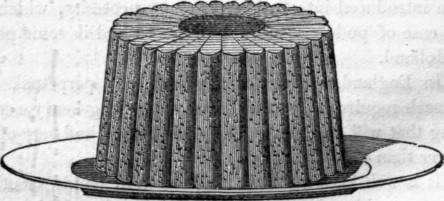
The cut below represents a pudding (any kind), made in a mould, scalloped, and hollow in the middle; any kind of mould may be used for puddings.
Continue to:


My Books

