


Stewed Fruits. Part 2
Description
This section is from the book "The Home Cook Book", by Expert Cooks. Also available from Amazon: The Home Cook Book.
Stewed Fruits. Part 2
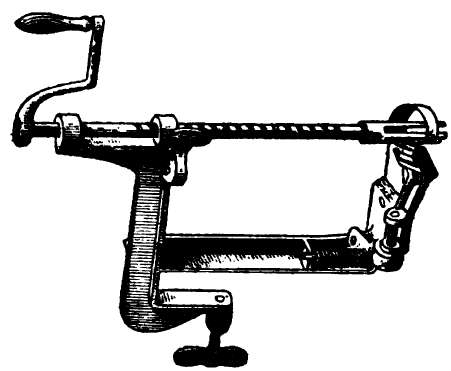
Apple Parer.
How To Bake Sour Apples
When baking apples do not remove the skins, even if it does not give the dish so sightly an appearance. Next to the skin lies the aromatic portion of the fruit. It is lost in paring. Choose the largest apples for baking. Wipe them clean, arrange in a granite or earthen dish, pouring a little water over and sprinkling with brown sugar. Bake in a moderate oven till soft, and cook to the core. Allow two or three hours if necessary. Turn occasionally during baking so they will cook evenly.
How To Bake Sweet Apples
Proceed as in the foregoing receipt, omitting the sugar.
To turn a drippingpan or other dish over the dish in which the apples, whether sweet or sour, are baking, helps them to cook by keeping in the steam, and gives an added flavor.
Baked sweet apples are delicious served with sweet cream poured over them.
Fried Apples
Fried apples add zest to a dish of sausage or pork chops. See "Fried Apples and Pork," page 123. Wash the apples, slice them without peeling, and put them in a fryingpan, the bottom of which is liberally covered with hot drippings or butter. Cover tight, and let them cook till soft over a moderate fire. Stir occasionally. Serve hot.
New England Pan Dowdy
Years ago, when eggs were a luxury not even obtainable at sixty cents a dozen the apple desserts of our grandmothers called for no eggs, yet their goodness can scarcely be surpassed today by the woman whose pride is fancy cooking.
Pan dowdy was always made in a deep yellow baking dish. The dish was liberally buttered, the bottom and sides were lined crustfashion with slices of buttered bread. It was filled with sliced apples, dusted with nutmeg or cinnamon, moistened with half a pup of hot water, one cup of brown sugar, and two tablespoons of molasses. Finish with a top crust of liberally buttered bread, cover with a plate, bake slowly for an hour and a half. Serve turned out on a platter and with cream or hard sauce.
Stewed Dried Apricots
Wash in three cold waters one pound of dried apricots. Put into a crock and cover them with cold water, which will be near one quart. Soak overnight. Next morning put into a goodsized preserving kettle with the water in which they have soaked. Add three pints more of cold water and one heaping teacup of sugar. After they begin to boil, stew them steadily and slowly one full hour and a half. The richness of fruit comes by slow boiling. Dried fruits are improved by stewing a long time, and gently.
These directions may be followed and the sugar omitted if a sour apricot sauce is wished.
Stewed Cranberries
Take one quart of cranberries, wash them in cold water, pour this off and put them in a porcelainlined saucepan and pour over enough cold water barely to cover them. Stir in one small teaspoon of soda, without dissolving it in water. When the berries boil the soda will foam. When it stops foaming, add one teacup of sugar. Boil slowly, and when the cranberries are half done, mash them with the back of a spoon. Let them continue to boil about one hour,, and when clear and rich they are done. Pour out into a crock or large bowl, and stir once in a while to prevent a scum forming over the top.
Baked Pears. A Jewish Receipt
Peel the pears and stick a couple of cloves in each pear. Put in an earthenware baking dish, sweeten to your taste, add water to afford plentiful juice in baking, and bake in a moderate oven till the pears are tender. Dip up the water in the pears now and then as they are baking.
Stewed Dried Prunes
Select a pound of mediumsized prunes. Wash them in three cold waters. Put them in a crock and cover with cold water overnight. In the morning put them in a preserving kettle with the water they were soaked in. Add two more quarts of cold water, one full teacup of sugar, one sliced lemon. Cook slowly until there is more than enough juice to cover them, as they will absorb the juice after they are done. It will take two hours to cook them slowly.
How To Stew Prunes Without Sugar
Wash the prunes thoroughly in several waters, cover with cold water and boil or simmer slowly until tender. They will have a thick syrup juice, and if of a good quality will have considerable sugar in themselves and be quite sweet enough for some tastes.
Stewed Quinces And Apples
Peel and cut three quinces in small sections. Cover them with plenty of water (without sugar) and cook until nearly tender. Save the peeling and cores, put them in another saucepan, cover well with water, and stew until the flavor of the quince has cooked into the water. Cut good flavored apples in small sections and add to the stewed quince. Strain and add the water in which the peelings and cores have boiled. Cover the mixed apples and quinces with water, sweeten to taste, and cook until the apples are rich and clear. Another way of flavoring apples is to boil ginger root with them, taking out the root when they are sufficiently flavored and adding several slices of lemon.
Stewed Rhubarb
Peel the rhubarb and cut it in inch pieces. Lay it in a large crock, wash quickly in cold water, and then cover with boiling water. Let it stand fifteen minutes, and pour off this water. Put it in a preserving kettle, and add a teacup of sugar to four cups of the fruit. Add no more water, as rhubarb is very juicy. Let it stew steadily until clear and rich. Taste carefully, and sweeten only just enough to leave a slight acid.
Continue to:


My Books

