


How To Carve Meat. Part 3
Description
This section is from the book "The Illustrated London Cookery Book", by Frederick Bishop. See also: How to Cook Everything.
How To Carve Meat. Part 3
Saddle Of Mutton
The tail end is divided in the engraving, and the kidneys skewered under each division; this is a matter of taste, and is not always done. Carve from A to b in thin slices, help fat from c to d. You may help from the vertebrae on both sides of the loin, and then carve cross-wise as marked in the engraving, which gives you both fat and lean; help a slice of kidney to those who desire it. Haunch of Mutton is carved as haunch of venison.

Saddle of Mutton.
Fore Quarter Of Lamb
Place your fork near the knuckle and cut from a to c, to B, and on to d; pass your knife under, lifting with the fork at the same time. The juice of half a lemon or Seville orange which has been sprinkled with salt and pepper, is then squeezed under the shoulder, and a slice of fresh butter placed there also, the parts are re-united until the butter is melted, and the shoulder is then placed upon a separate dish; separate the neck from the ribs, from e to d, and then assist the breast G, or the neck f, according to the palate of your guest.
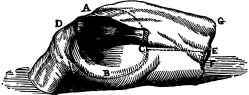
Fore Quarter of Lamb.
Haunch Of Venison
Have the dish placed before you so that the loin is nearest to you, and the knuckle farthest, then cut from a to b, sufficiently near the knuckle to prevent the escape of any gravy, then make your first cut from a to c, with a slanting cut, and then let each succeeding slice be sloping so that all the gravy may be retained in the hollow thus formed; the fat will be found at the left side, and must be served with the meat.
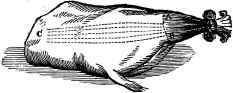
Haunch of Venison.
Neck of Venison thould be carved across the ribs, as in the neck of veal, or length-wise, from one end of the neck to the other.
Kid, if kept until the age at which lambs are killed, is served and carved in the same manner; if killed at a month or five weeks, they are roasted whole and carved in the kitchen.
Pork
The leg when sent to table should be placed with the back uppermost and the crackling be removed; if sufficiently baked, this may he done with ease; the meat should be served in thin slices cut across the leg, the crackling being served with it, or not, according to taste; the loins ate cut into the pieces as scored by the hatcher.
Ham
It is served as placed in the engraving, and should come to table ornamented. Carve from a to B, cutting thin slices cut slantingly, to give a wedge-like appearance. Those who prefer the hock carve at d, in the same direction as from a to b, then carve from d to c, in thin slices, as indicated in the diagram.
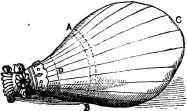
Ham.
Boiled Tongue. Carve across the tongue, but do not cut through; keep the slices rather thin, and help the fat from underneath.
Continue to:


My Books

