


Ranges, Stoves, Hot Water Apparatus, Etc
Description
This section is from the book "The Illustrated London Cookery Book", by Frederick Bishop. See also: How to Cook Everything.
Ranges, Stoves, Hot Water Apparatus, Etc
1. The Oxford Roasting Range, the first specimen of which in London was introduced at the celebrated kitchen of the Reform Club, by Messrs, Benham and Song, of Wigmore Street, though it has since been adopted in many other large establishments. It has an open fire, with vertical bars instead of the ordinary and familiar horizontal ones; but its peculiar excellence consists in the intense heat radiated from it, and its great economy of fuel - -the space from the bars to the back being less than half the usual depth. The back is formed of Stourbridge fire-clay. The size of the fire may he increased or diminished at pleasure; and the whole of the front opens on hinges like a gate, so as to give ready access for the removal of cinders, etc. The boiler for hot water is placed behind the back.
Benham's Improved Family Range (not illustrated) is made on the same principle as the Oxford Roasting Range, but on a smaller scale for families. It has the fire-clay radiating back, iron water boiler, vertical bars, etc., and in addition to them, a very excellent oven for meat, pastry, or bread heated from the same fire. This is a most useful and economical form of range; and the consumption of fuel, we are told, is surprisingly small, averaging only thirty pounds of coal for twelve hours in a moderate sized range.
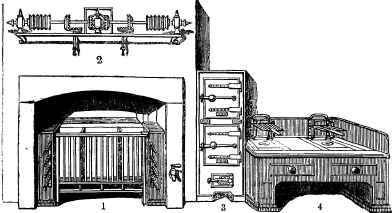
2. Improved Smoke Jack, with double movements, dangle spits, and universal joints; equally applicable to almost every description of range, either close or open. The apparatus is kept in motion solely by the upward current of air in the chimney without springs or weights.
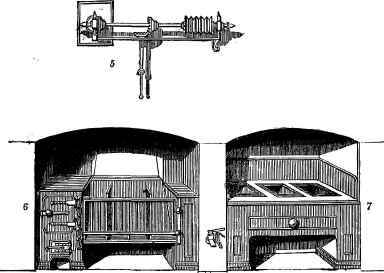
5. The same as No. 2, with single movements, for a smaller range.
3. Oven and Hot Closet, with separate furnace underneath; preferred by many professional cooks to those which are heated by the range fire.
4. Hot Plate and, Broiling Stove, with a moveable gridiron, all heated by one fire. The top and front are all of iron, and the draft can be regulated with the greatest accuracy by the sliding doors in the front.
6. The Oxford Range, with an Oven at the side; heated by a separate furnace - in other respects similar to the Family Range.
7. Stewing Stoves, heated by charcoal, and therefore requiring no flue. These are considered by many professed cooks quite indispensable for some of their more delicate operations, which require a less intense heat than that of the Hotplate.
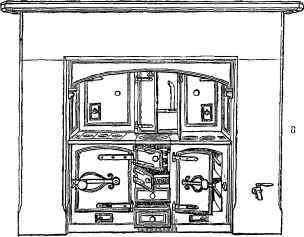
8. A Close Range with two ovens, hot closet, boiler, and hotplate, all heated from one central fire. Pipes can also be attached to carry steam to various kettles and saucepans, for boiling vegetables, etc., if required. The ashes fall into a drawer under the fire. This is a useful and economical form of range, but unless great care is taken it is apt to overheat the kitchen; and as the chimney is obliged to be enclosed entirely or partially, the ventilation is not nearly so perfect as with an open range.
There are, of course, very many other forms of kitchen ranges, each possessing its peculiar merit in a greater or less degree, but these will illustrate the one important feature by which all may be distinguished; they are open or close. Into the question of their comparative excellence we cannot pretend to enter here.
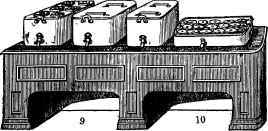
9. Steam Kettles, for cooking meat, vegetables, fish. They may be of any convenient size or shape; may be placed at the most distant part of the kitchen or skullery, and the steam conveyed to them by a pipe from the range boiler.
10. Bainmarie Pan, with a set of stewpan, soup-pots, and glazepot, and made with a double body to be heated by steam from the boiler. This is filled with hot water, in order to keep the soups, sauces, &c„ perfectly hot, without burning or drying them up.
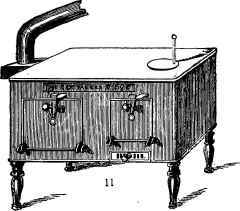
11. The Cottager's Stove is an economical, compact, and portable cooking apparatus, combining a good-sized oven and hotplate. It will cook for a dozen persons with one pound of coal or coke per hour, and the top may also be used as an Ironing Stove. It requires no fixing, has no flues to clean, may be placed in any apartment, and is a great security against fire. There were specimens of these stoves in Prince Albert's Model Houses in Hyde Park; they are specially adapted for cottagers, emigrants, working men, etc, and are also found very useful as occasional adjuncts to private kitchens.
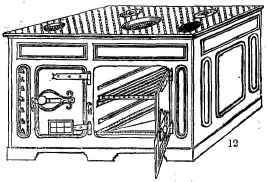
12. Gas Cooking Apparatus. Contrary to the prejudices of very many, and the early experience of some, it is now found that roasting, baking, boiling, frying, stewing, and broiling may be performed by the aid of gas as effectually as with a coal fire - with much more cleanliness, and without imparting the slightest taint or smell of gas to the food. The apparatus shown embraces all these points; but they are made of various sizes, and more or less complete, as may he desired.
We have thus given an accurate description of cooking utensils and appliances, the number required must depend upon the position of the head of the establishment, and may be multiplied as necessity requires.
We will now give a few
Which they will not regret following with attention.
Let there be a place for every article, and when not in use let every article be in its place.
Keep every utensil clean and ready for immediate use.
The stock pot should never be suffered to be empty, as almost any meats (sate salt meats) or fowls make stock; the remnants should never be thrown anywhere but into the stock pot, and should too much stock be already in your possession, boil it down to a glaze: waste is thus avoided.
Continue to:


My Books

