


How To Mould Aspic Jelly
Description
This section is from the book "Practical Cooking And Serving", by Janet McKenzie Hill. Also available from Amazon: Practical Cooking and Serving: A Complete Manual of How to Select, Prepare, and Serve Food [1919].
How To Mould Aspic Jelly
For use in the first two ways, turn the liquid when cold, but before it begins to set, into perfectly clean and chilled pans of a size the required thickness demands. Always be careful that any dish containing aspic stands perfectly level.
For use in the third way, simply pour the cooled aspic into the chilled moulds, unless the moulds are to be decorated. In this latter case, turn the chilled mould with a tablespoonful - less or more, according to the size of the mould - of chilled aspic round and round until the surface is lightly coated; set in ice and water until firm enough to keep in place, then arrange upon it the decorations, adding a drop of aspic to each, to hold it in place. Let the chilled but liquid aspic stand, meanwhile, in a saucepan of lukewarm water, in order to keep it in the right condition to use. After the decoration is firmly set, cover with more aspic, and when that is set, add a stoned or stuffed olive or any trifle that is desired; keep this in place with a drop or two of aspic and then gradually fill the mould. The same method is employed when the aspic is used for the fifth purpose.
When the aspic is used to line a mould to the depth of half an inch or more, two moulds of the same shape, one larger than the other, are needed. Charlotte moulds are the style most often used. This is called double moulding.
Double Moulding
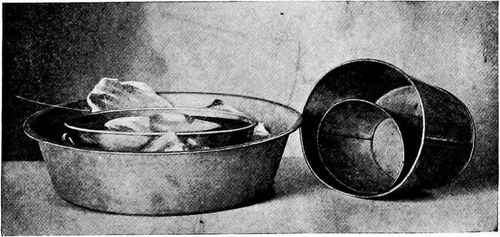
Charlotte Moulds In Pan Of Ice And Water. Double Moulding
Select two moulds similar in shape, one an inch or more larger than the other. Set the larger mould in a pan of ice and water, pour in liquid jelly to the depth of an inch and, when chilled and firm, place the smaller mould filled with ice upon the jelly and exactly in the centre; add water to the ice, then fill the outside mould with the liquid jelly; let stand until firm, then dip out the ice and water from the inner mould, replace with warm water and at once lift out the smaller mould; fill the open space to within an inch of the top with the salad mixture, cream or mousse preparation, or whatever is desired, and when this is firm cover with liquid aspic.
To Unmould Aspic Or Other Jellies, Etc
Immerse the mould to the height of the contents in warm - not hot - water; with a pointed knife loosen if necessary the jelly at the upper edge, turning the mould meanwhile from side to side, to make sure that the jelly has separated from the sides; then invert on the serving-dish and carefully lift the mould.
A delicate jelly cannot be easily moved after it has fallen from the mould, and care should be exercised, at first, to place it evenly in the centre of the dish. If unmoulded on a lace or dish paper, the jelly may be moved on the paper. To change the position on a dish, when no paper has been used, carefully replace the mould over the mixture, then invert both together and separate the jelly from the dish with a spatula.
To Coat Chaudfroids With Aspic Jelly
If the object covered with chaudfroid sauce be small, hold it on a broad knife-blade and pour the liquid aspic over it. A large object may be set on a meat rack over a large dish. The aspic may be put on with a brush; a spoon, however, is usually preferable.
Continue to:


My Books

