


Iced Puddings And Ornamented Entremets
Description
This section is from the book "The Modern Cook: A Practical Guide to the Culinary Art in All Its Branches", by Charles Elme Francatelli. Also available from Amazon: The Modern Cook: A Practical Guide to the Culinary Art in All Its Branches.
Iced Puddings And Ornamented Entremets
Comprising Iced Cake, d la Stanley.
Iced Rice Padding, a' la Cintra.
Iced Pudding, a' la Cerito.
a' la Prince of Wales.
a' la Chesterfield.
a' la Kinnaird.
a' la Prince Albert.
a' la Parisienne,
Biscuit glaces, in small cases. Nesselrode Padding. Iced Pudding, a' la Princess Alice. Millefeuilles Cake, d la Chantilly. Apples and Rice, ornamented.
Apples and Rice, plain.
a' la Portuguaise.
in the form of a Porcupine.
d la Portuguaise, another way. Flan of Peaches.
Napolitaine Cake, d la Chantilly. Croquante of Oranges.
of Fresh Walnuts.
of Ratafias, a' la Chantilly.
Meringue, a' la Parisienne. Grosse-Meringue, with Pistachios. Swan of Savoy Biscuit, d la Chantilly. Savoy Cake, in the form of Glazed Ham
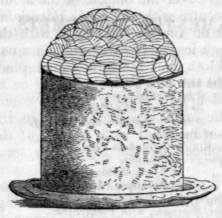
1338. Iced Cake, A La Stanley
First, make a Parisian cake (in a fluted mould), as directed in No. 1273. Next, prepare a compote of greengages in syrup; these must be kept whole, and of as green a color as possible. Then, prepare a custard in the following manner: - Mix ten yolks of eggs with a pint and a half of boiling cream, eight ounces of sugar, and sufficient cinnamon and lemon-peel to flavor it; add a very little salt, and stir the whole in a stewpan over the fire until it begins to thicken ; the custard should then be immediately passed through a tammy or sieve, into a basin, and allowed to become 29 cold. This custard must now be placed in a freezing-pot used for making ices, and should be occasionally worked with a spatula as it becomes set by freezing; when frozen sufficiently firm, scrape the custard from the sides of the pot, and gather it all up at the bottom; put the lid on with paper to exclude the hot air, pour off the water from the tub, and after the pot has been packed in with fresh ice and salt, place a damp cloth over the top, and keep it in a very cool place until wanted.

When about to send the cake to table, scoop out nearly the whole of the crumb from the centre, and fill it with the iced custard ; place it on its dish, pile up the compote of greengages on the top, as represented in the wood-cut, pour some of the syrup round the base, and serve.
1339. Iced Rice Pudding, A La Cintra
Wash and parboil eight ounces of Carolina rice; then, put it into a stewpan, with a quart of milk and a pint of cream, two sticks of vanilla, twelve ounces of sugar, and a little salt; allow the rice to simmer very gently over or by a slow stove-fire, until the grains are almost dissolved, stirring it over occasionally with a light hand. When the rice is done, and while it is yet in a boiling state, add the yolks of six eggs; then stir the whole well together for several minutes, in order to mix in the eggs, and also for the purpose of breaking up and smoothing the rice. Let this rice-custard be frozen in the same manner as directed in the foregoing case, and then put it into a plain mould; cover it with the lid, and immerse it in the ice in the usual way.
While the above part of the process is going on, a compote of twelve oranges (Tangerene, if in season) should be prepared in the following manner: - First, cut each orange into halves, remove the pithy core and the pips with the point of a small knife; then, with a sharp knife, pare off the rind and white pith, so as to lay the transparent pulp of the fruit quite bare, taking care to trim them neatly, and without waste; when the whole of the fruit is ready, throw it into a convenient-sized sugar-boiler, or stewpan, containing about a pint of syrup (made with one pound of sugar, and nearly a pint of spring-water), allow the pieces of orange to boil up gently in this for two minutes, and then drain them on a sieve. Boil the syrup down to about one-half of its original quantity; then, add two wine-glasses of curacao, and three table-spoonfuls of apricot-jam; mix the whole together, and pour it over the oranges in a basin.
When about to send the pudding to table, turn it out of the mould, and place it on its dish, dress the compote of oranges on the top and round the base, as represented in the wood-cut, pour the syrup over it, and serve.
Continue to:


My Books

