


Iced Puddings And Ornamented Entremets. Part 9
Description
This section is from the book "The Modern Cook: A Practical Guide to the Culinary Art in All Its Branches", by Charles Elme Francatelli. Also available from Amazon: The Modern Cook: A Practical Guide to the Culinary Art in All Its Branches.
Iced Puddings And Ornamented Entremets. Part 9
1359. Croquante Of Fresh Walnuts
The fittest season for making this, is when the walnuts are just ripe enough to be easily taken out of the shell; about sixty will be required for the purpose. They must be carefully shelled and divided into halves, then freed from the thin whitish skin which covers the kernels, and kept in a clean napkin until used. In all other respects, this kind of croquante must be finished as in the preceding case.
1360. Croquante Of Ratifas, A La Chanttlly
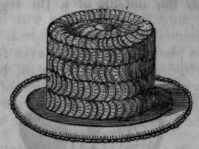
Procure one pound of small ratafias ; boil down one pound of the finest loaf-sugar as directed in the foregoing case. Then, slightly rub the inside of a basket-shaped mould with oil, and proceed to line this with the ratafias lightly dipped in the sugar - taking care to arrange them in neat and close order; when the croquante is completed, and the sugar has become firmly set, turn it out of the mould. With the remainder of the sugar, form the handles, and a scroll-pattern border, which is to be placed round the join of the basket, and also round the edge: this is effected by dipping the pointed end of the bowl of a spoon into the hot sugar, and then drawing it out, and dropping the sugar from the bowl, in the form of the intended design, on a baking-sheet slightly oiled; before it becomes set, fix it round the part it is to ornament. Just before sending the croquante to table,' fill the inside with whipped cream, arrange some strawberries, preserved cherries, or cut angelica, neatly on the surface, and serve.
* When boiling sugar for this purpose, it is customary to add a pinch of cream of tartar and calcined alum mixed, or, a few drops of acetic-acid.
1361. Meringue, A La Parisienne
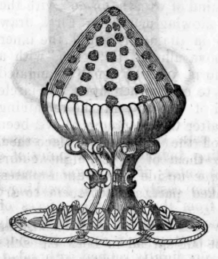
First, make half a pound of office-paste (No. 1257); then, slightly rub the outside of a tin vegetable-cutter, about one and a quarter inch in diameter, and cover this to the extent of about three and a half inches in length, with some of the office-paste rolled out rather thin ; fasten the joint neatly with egg, and place it on a baking-sheet; roll out the remainder of the paste to the thickness of the eighth part of an inch, and, out of this cut two circular pieces or flats, one measuring about six inches, and the other four inches in diameter ; place them on a buttered baking-sheet, egg them over, prick them with a fork, and bake them of a light color, in a slow oven. When they are done, and have become cold, file or scrape their edges even and smooth, and cut the ends of the pillar even, that it may stand perfectly level; then fasten the base of the pillar on to the centre of the largest flat, with a little white of egg and fine sugar mixed together; next, fasten the smaller flat on the top of the pillar in like manner, taking care that it is quite straight, and put the whole to dry in the screen.
Whip twelve whites of eggs into a firm substantial froth, and then mix in one pound of finely-sifted sugar; use part of this to mask the entire surface of the foundation already described, and set this to dry at the entrance of the oven; when it has become comparatively hard, fill a paper cornet or biscuit forcer, with some of the meringue-paste, and use this to form the design round the pedestal of the meringue, as represented in the wood-cut: when this is done, shake some sugar over it, and put it into the oven to be baked of a very light-fawn color. With part of the meringue-paste, a kind of cup or deep saucer, measuring about seven inches in diameter, must be formed, by cover-illg a flat dome (made of tin) with the paste to the thickness of about an inch; this must be well sugared over and baked firm, without allowing it to acquire much color. When this is done, take the me-ringue carefully off the dome, and place it upside down in a soup plate, and after the white of egg has been partially removed from the interior, smoothed with a spoon, and then sugared over, set it to dry in the hot-closet, or at the entrance of the oven, if the latter is not too hot. As soon as the meringue has become dry and hard, fasten it on the pedestal with a little of the paste, and use a paper cornet filled with meringue -paste, to finish ornamenting the edge and sides, as represented in the wood-cut; shake some sifted sugar over the unbaked part, and put the meringue to dry in the hot-closet, taking particular care that it does not acquire any color. Just before sending to table, place the meringue on a napkin in its dish, fill it with whipped cream flavored with orange-flower or some liqueur, and strew some strawberries on the surface; garnish round the base with quarters of lemons or oranges filled with jelly (No. 1429), and serve.
Continue to:


My Books

