


Instructions For Carving. Part 3
Description
This section is from the book "The London Art Of Cookery and Domestic Housekeepers' Complete Assistant", by John Farley. Also available from Amazon: The London Art of Cookery.
Instructions For Carving. Part 3
Goose
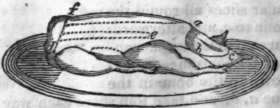
Cut off the apron in the line a, b, c, pour in the sauce (see Sauces), and cut the breast in long slices in the line d, e; this will make the wings smaller, but more prime pieces may be thus taken: divide the wing by passing the knife through the joint at d, and the leg in the same manner at e: cut off the merry-thought at d,f, and having divided the pinions, cut off the neck bones, and separate the breast from the back : cut off the side-bits, or sidesmen, from the back, and divide that into two parts. It requires much practice to carve a goose neatly. Help each person to a little of the seasoning and aravv.
Ducks, Teal, And Wild Fowl
Are, in general, very nearly carved in the same manner as goose.
Turkey
Take slices from the breast in the line from a to b, and proceed exactly in the same manner as above directed for goose, observing, that the parts nearest the wings are most delicate, and help a little of the liver, if approved of, to each person. The gizzard is generally devilled; to do which, score it all over with the point of the knife, and having mixed up a spoonful of mustard, a little cayenne and salt, rub the composition over the whole, and send it out to be broiled.
Fowl
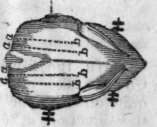
Take off the wing in the direction from a to b; slip the knife between the body and leg, and turn it back with the fork: proceed afterwards as already directed for carving goose.
Pheasant
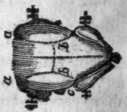
Slice down the breast in the line a, b; take off the leg in the direction of the line b, d, and cut off the wing in the line c d; separate the leg and wing on the other side, and cut off the slices of the breast; cut off the merry-thought in the line f, g, and proceed as above directed for goose. The prime parts are the breast, wings, and merry-thought, although the leg is of a higher flavour.
Partridge
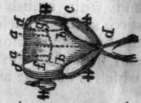
Is carved in the same manner as a fowl; the wings must be taken off in the lines a, b, and the merry-thought in the line c, b: the most esteemed parts are, the wings, breast, and merry-thought.
Pigeons
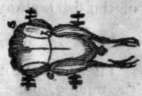
May be either cut in halves from top to bottom, or across : the most approved way is to cut from the neck to a, rather than from c to b, by a.
Cod's Head
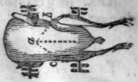
With the fish-knife or trowel, take off a piece quite down to the bone, in the direction a, b; c, d; putting in the trowel at a, c; and with each slice of fish give a piece of the sound, which lies underneath the back-bone and lines it. The parts about the back-bone on the shoulders are the best; and about the head are many delicate parts, and a great deal of the jelly kind.
Salmon
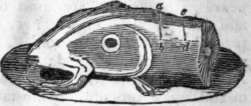
With the point of a sharp carving-knife, take slices in the direction of the lines a, b, and c, d; and with a fish-trowel serve slices of each part; the back being more dry and firm than the belly, which is both fat and rich.
Turbot
Enter the fish-knife or trowel in the middle over the backbone, and take off a piece of the fish, as much as will lie on the trowel, on one side close to the bones. The thickest part of the fish is always the most esteemed.
Soles
These may be either boiled or fried. Cut them right through the middle, bone and all, and give a piece of the fish, in pro-portion to the size of it, to each person.
Mackerel
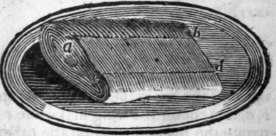
Slit this fish all along the hack with a knife, and take off one whole side, not too near the head, because the meat about the gills is generally black and ill-flavoured.
Eels
Cut these into pieces quite through the bone. The thickest part is the most esteemed.
Besides these, there are many other little articles brought to table; but as they are mostly simple in their nature, a little observation and practice will make complete proficients in the art of carving,
Continue to:


My Books

