


Pork
Description
This section is from the book "The London Art Of Cookery and Domestic Housekeepers' Complete Assistant", by John Farley. Also available from Amazon: The London Art of Cookery.
Pork
Measly pork is very dangerous to eat; but this state of it is easily discovered, by the tat being full of little kernels. If it is young the lean will break on being pinched, and the skin will dent, by nipping it with the fingers; the fat, like lard, will be soft and pulpy. If the rind is thick, rough, and cannot be nipped with the fingers, it is old. If the flesh is cool and smooth, it is fresh ; but if it is clammy, it is tainted; and, in this case, the knuckle part will always be the worst. Ob-serve, a thin rind is always best.
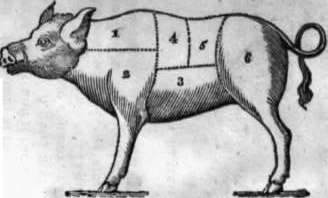
The Joints In A Pig Are
The parerib - - | No. 1 |
Hand - - | 2 |
Belly or spring - | 3 |
Fore loin 1 • I ore-loin - | 4 |
Hind-loin - | 5 |
Leg - | 6 |
Pork intended for roasting, should be always previously sprinkled with salt, as it eats with much more relish.
Hams. Those are the best which have the shortest shank. If you put a knife under the bone of a ham, and if it come out clean, and smell well, it is good; but if it is daubed and smeared, and has a disagreeable smell, be sure not to buy it.
Bacon
If bacon is good, the fat will feel oilv, and look white, and the lean will be of a good colour; and stick close to the bone; but it is, or will be rusty very soon, if there are any yellow streaks in the lean. The rind of young bacon is always thin; but thick, if old.
Brawn
The rind of old brawn is thick and hard ; but young, if moderate. The rind and fat or barrow and sow brawn are very tender.
Continue to:


My Books

