


Veal
Description
This section is from the book "The London Art Of Cookery and Domestic Housekeepers' Complete Assistant", by John Farley. Also available from Amazon: The London Art of Cookery.
Veal
The flesh of a cow-calf is whiter than that of a bull, but the flesh is not so firm; the fillet of the former is generally preferred, on account of the udder; if the head is fresh, the eyes will be plump; but if stale, they will be sunk and wrinkled. If the vein in the shoulder is not of a bright red, the meat is not fresh: and if there are any green or yellow spots in it, it is very bad. A good neck and breast will be white and dry; but if they are clammy, and look green or yellow at the upper end, they are stale. The kidney is the soonest apt to taint in the loin, and if it is stale, it will be soft and slimy. A leg is good if it be firm and white ; but bad if it is limber, and the flesh flabby, with green or yellow spots.
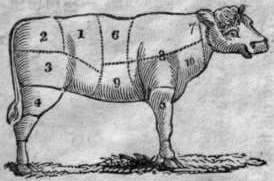
The Joints In A Calf Are
No.
Loin, best end - 1
Ditto, chump ditto 2
Filler ----- 3
Hind-knuckle 4
Fore-knckle 5
Neck, best end - - - - 6
Ditto, scrag ditto - - 7
Blade-bone . - - - 8
Breast, best end - - 9
Ditto, brisket ditto - - - 10
Care Of The Different Joints
Leg. - Wipe the udder perfectly dry : take out the skewer which fastens down the udder, and rub the hole with salt . and take out the kernel from the thick fat.
Loin. - Cut out the pipe running along the chine.bone ; wipe dry with a cloth; examine the k:dnev of the loose side, wipe dry; and having taken out the kernel in the inside of the chump, sprinkle the whole over slightlv with salt.
Keck. - Cut out the pipe running along the chine-bone ; wipe the chiue and the inside of the ribs very dry and slightly sprinkle with salt.
Breast. - Cut off the skirt on the inside, rub dry, and sprinkle with salt.
Continue to:


My Books

