


Meats, Stock Soups, And Gelatin. Part 2
Description
This section is from the book "A Laboratory Manual Of Foods And Cookery", by Emma B. Matteson. Also available from Amazon: A Laboratory Manual of Foods and Cookery.
Meats, Stock Soups, And Gelatin. Part 2
Meat Experiments
129. - Examine a shin of beef for fat, connective tissue, tendons, ligaments, blood vessels (veins and arteries), bone tissue, and muscles.
Prepare round steak for the following experiments by grinding through meat grinder.
130. - a. Mix 2 tbsp. meat and 1 c. cold water. Let stand 1 hour.
b. Mix 2 tbsp. meat and 1 c. cold water and 1/2 tsp. salt. Let stand 1 hour.
c. Mix 2 tbsp. meat and 1 c. cold water and 1 tbsp. vinegar. Let stand 1 hour.
d. Mix 2 tbsp. meat and 1 c. warm water and 1/2 tsp. salt. Let stand 1 hour.
e. Mix 2 tbsp. meat and 1 c. boiling water. Boil 1 minute, and let stand 1 hour. Compare results. In which instances is most color and flavor extracted ? Explain these phenomena.
131. - Remove as much muscle and fat as possible from a shoulder of veal. Crack the bone in several places. Place in cold water to cover, adding 1/2 tsp. salt to each pint of water and let simmer for 6 hours. Remove the bone, strain the liquid through a wet cheesecloth, and put in a cold place to cool. Let the stock remain in ice box overnight and then observe change in consistency. (Keep for Expt. 132.) a. Note the layer of fat on surface covering the jelly underneath. Could the small amount of fatty tissue left on the bone have furnished enough fat to form such a layer?
b. What was the source of the fat?
132. - To a small portion of the jelly from Expt. 131 apply the following tests: a. Biuret, page 85.
b. Xanthoproteic, page 85.
c. Fehling-Benedict, page 13.
d. Iodine, page 13.
133. - Note the color and flavor of the jelly. Why is it lighter colored and lacking in flavor? What kind of meat is added to soup stock for color and flavor? Why?
134. - Rub a piece of tough round steak with a small amount of baking soda. Allow it to stand 1/2 hour and then pan-broil. Repeat, using vinegar or lemon juice. Broil. Compare as to flavor, texture, ease of cutting with silver knife, and mastication. How do you account for the differences observed?
135. -Again prepare pieces of steak, A and B, as in Expt. 134. Put A in a hot frying pan, B in a cold frying pan. Turn each as soon as seared on one side. Compare as to texture, flavor, and amount of gravy left in pan.
Conclusions
136. - Cut bacon into slices A, B, and C -
A cut very thin B cut moderately thin C cut thick | weigh each |
Fry each to the following stages: rare, medium, and crisp. Weigh the amount of fat left in pan in each case. How much is lost?
137. - Use slices cut as in A, B, C. Broil and compare with products in Expt. 136. Which method of preparing bacon is best? Why?
138. - a. Prepare a meat stew in both the pressure and fireless cooker.
b. Compare the thoroughness of cooking, length of time required, flavor.
c. Compute the saving in time, labor, and fuel. Note the temperature of each cooker.
d. What are the advantages of the pressure and the fireless cookers over the coal or gas stove?

1. Neck.
2. Chuck.
3. Ribs.
4. Shoulder clod.
5. Fore shank.
6. Brisket.
7. Cross ribs.
8. Plate.
9. Navel.
10. Loin.
11. Flank.
12. Rump.
13. Round.
14. Second cut round.
15. Hind shank.

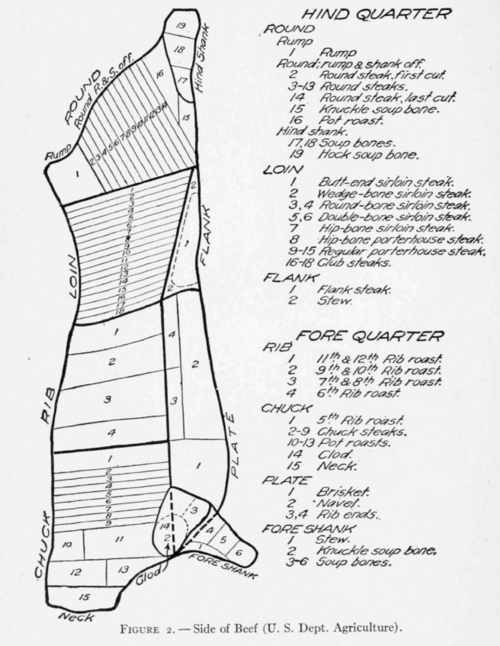
Figure i. - Cuts of Beef (U. S. Dept. Agriculture).

1. Neck.
2. Chuck.
3. Shoulder.
4. Fore shank.
5. Breast.
6. Ribs.
7. Loin.
8. Flank.
9. Leg.
10. Hind shank.

Figure 3. - Cuts of Veal (U. S. Dept. Agriculture).


1. Neck.
2. Chuck
3. Shoulder.
4. Flank.
5. Loin.
6. Leg.
Figure 4.- Cuts of Lamb and Mutton (U. S. Dept. Agriculture).

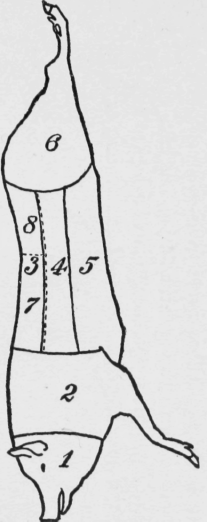
1. Head.
2. Shoulder.
3. Back.
4. Middle cut.
5. Belly.
6. Ham.
7. Bibs.
8. Loin.
Figure 5.- Cuts of Pork (U. S. Dept. Agriculture).
Continue to:


My Books

