


Planting The Lawn. Part 3
Description
This section is from the book "Amateur Gardencraft", by Eben E. Rexford. Also available from Amazon: Amateur gardencraft.
Planting The Lawn. Part 3
It must not be inferred that the list of trees of which mention has been made includes all that are desirable for planting about the home. There are others of great merit, and many might prefer them to the kinds I have spoken of. I have made special mention of these because I know they will prove satisfactory under such conditions as ordinarily prevail about the home, therefore they are the kinds I would advise the amateur gardener to select in order to attain the highest degree of success. Give them good soil to grow in, and they will ask very little from you in the way of attention. They are trees that anybody can grow, therefore trees for everybody.
In planting a tree care must be taken to get it as deep in the ground as it was before it was taken from the nursery. If a little deeper no harm will be done.
Make the hole in which it is to be planted so large that all its roots can be spread out evenly and naturally.
Before putting it in place, go over its roots and cut off the ends of all that were severed in taking it up. Use a sharp knife in doing this, and make a clean, smooth cut. A callus will form readily if this is done, but not if the ends of the large roots are left in a ragged, mutilated condition.
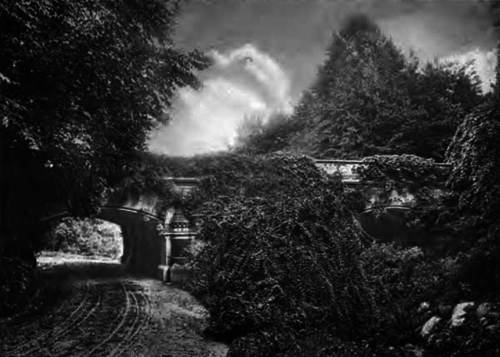 SHRUBS ALONG THE DRIVEWAY
When the trees are received from the nursery they will be wrapped in moss and straw, with burlap about the roots. Do not unpack them until you are ready to plant them. If you cannot do this as soon as they are received, put them in the cellar or some other cool, shady place, and pour a pailful of water over the wrapping about the roots. Never unpack them and leave their roots exposed to the air for any length of time. If they must be unpacked before planting, cover their roots with damp moss, wet burlap, old carpet, or blankets, - anything that will protect them from the air and from drying out. But - get them into the ground as soon as possible.
When the tree is in the hole made for it, cover the roots with fine soil, and then settle this down among the roots by jarring the trunk, or by churning the tree up and down carefully. After doing this, and securing a covering for all the roots, apply a pailful or two of water to firm the soil well. I find this more effective than firming the soil with the foot, as it prevents the possibility of loose planting.
Then fill the hole with soil, and apply three or four inches of coarse manure from the barnyard to serve as a mulch. This keeps the soil moist, which is an important item, especially if the season happens to be a dry one. If barnyard manure is not obtainable, use leaves, or grass-clippings - anything that will shade the soil and retain moisture well.
Where shall we plant our trees?
This question is one that we often find it difficult to answer, because we are not familiar enough with them to know much about the effect they will give after a few years' development. Before deciding on a location for them I would advise the home-maker to look about him until he finds places where the kinds he proposes to use are growing. Then study the effect that is given by them under conditions similar to those which prevail on your own grounds. Make a mental transfer of them to the place in which you intend to use them. This you can do with the exercise of a little imagination. When you see them growing on your own grounds, as you can with the mind's eye, you can tell pretty nearly where they ought to be planted. You will get more benefit from object-lessons of this kind than from books.
On small grounds I would advise keeping them well to the sides of the house. If any are planted in front of the house they will be more satisfactory if placed nearer the street than the house. They should never be near enough to the dwelling to shade it. Sunshine about the house is necessary to health as well as cheerfulness.
Trees back of the dwelling are always pleasing. Under no circumstances plant them in prim rows, or just so many feet apart. This applies to all grounds, large or small, immediately about the house. But if the place is large enough to admit of a driveway, a row of evergreens on each side of it can be made an attractive feature.
The reader will understand from what I have said that no hard-and-fast rules as to where to plant one's trees can be laid down, because of the wide difference of conditions under which the planting must be made. Each home-owner must decide this matter for himself, but I would urge that no decision be made without first familiarizing yourself with the effect of whatever trees you select as you can see them growing on the grounds of your neighbors.
Do not make the mistake of planting so thickly that a jungle will result after a few years. In order to do itself justice, each tree must have space enough about it, on all sides, to enable it to display its charms fully. This no tree can do when crowded in among others. One or two fine large trees with plenty of elbow-room about them will afford vastly more satisfaction than a dozen trees that dispute the space with each other. Here again is proof of what I have said many times in this book, that quality is what pleases rather than quantity.
If any trees are planted in front of the house, choose kinds having a high head, so that there will be no obstruction of the outlook from the dwelling.
Continue to:


My Books

