


Horticulture At Cornell
Description
This section is from the book "The American Garden Vol. XI", by L. H. Bailey. Also available from Amazon: American Horticultural Society A to Z Encyclopedia of Garden Plants.
Horticulture At Cornell
The visitor to Cornell finds a great and growing general university, in which horticulture has a name and a place. The grounds of the horticultural department occupy about thirty acres of the University farm. The most of this area has a slightly western or southern exposure, but, taken as a whole, it is very uneven and lies in nearly all directions. The character of the soil also varies widely. Some portions are heavy tenacious clay, while others are sandy or gravelly.
A considerable portion near the forcing-houses, and adjoining the residence of the professor of horticulture, is set aside as a sort of show ground in the matter of experimental work, where things of special interest can be grown. Here we find a row of the different species of our native wild grapes, about twenty in number. Only three of these sorts have been improved, while nearly all our present varieties come from the Vitis Labrusca. The possibilities of the others are unknown, and it is the intention to make some advancement in this direction, as well as making something of a specialty of crossing and growing seedling fruits in general. The most important line of experimental work is believed to lie in the introduction and production of new varieties. Foreign and curious vegetables in great variety are grown upon this interesting plot of ground.
Near at hand is the small fruit plot, which is well under way. It should be remembered that this department has been established but one year and cannot make the showing which it will when a few years older. On the east and west sides of the plot is a double row of apple trees, while at the north is the cherry orchard. Still back of these, along part of the north and west sides, is a heavy row of native plums of the Wild Goose type. When these trees are grown, they will, make a somewhat sheltered spot for the small fruits. Such protection is much needed, for the station is located on high ground, fully exposed to severe sweeping winds. Just beyond the cherry orchard, on a steep bank facing north, is the vineyard of some fifty varieties, with mulberries interspersed in true Old World style. Below this, on a comparatively level piece of land, which is the most sheltered spot on the grounds, are the strawberries.
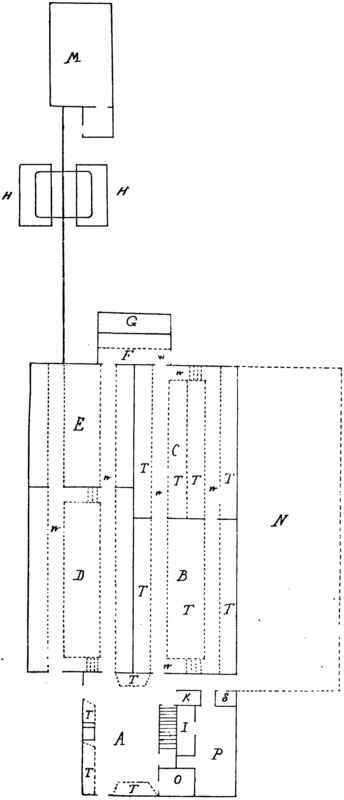
To the south-east of the forcing houses, on clay loam, with general western exposure, is the orchard of plums, standard pears and apricots. This orchard will be a matter of much interest as time goes on, for it is to be run on a commercial fertilizer basis exclusively. No stable manure has ever been put on the land, and it is the intention that none shall ever be used there. A dwarf pear orchard is to be planted near by the coming spring, and this will be treated in the same way. It is evident that there must be a constantly increasing interest in the question of profitable fruit growing without stable manures. At this season, the forcing-houses are of more interest than anything else. These are somewhat novel in construction, and consist of two runs of houses, each 20 x 60 feet, one end of the runs being covered by a potting house and the other by a transverse glass-house. One of the glass structures was built the past fall, the other something over a year ago. A ground plan is shown in the engraving.
The potting house, built across the west end in front of the glass-house, has on the ground floor a workroom, A ; with potting tables for students, and seed case, an office, 0; clothes-room, K; a well arranged photographic room, P, having overhead and side light, and a dark closet I for manipulating the plates. Hundreds of photographs of fruits and vegetables are taken during the season, and this makes a very useful addition to the equipments. Overhead is an attic with a workbench and storage room for many of the requisites of greenhouse work.
The boiler-room under this building contains a low-pressure steam boiler, so arranged that it can be used for hot-water heating at any time without change, by simply securing the safety valve to pre-vent leaking there, and filling the boiler and pipes with water, leaving the supply cock open to allow the water to expand back into the water works. This modern method of hot-water heating is proving far more effective and satisfactory than the old plan of using large cast-iron pipes entirely under the benches. There is some overhead heat and the pipes, being thinner, transmit the heat better. If water is not supplied from a water-works system, or if the pressure is too great to admit of expansion in that direction by leaving the supply cock open, it is necessary to provide an expansion tank. This may be a very simple and cheap affair, however.
The house put up the past fall is 20x60 feet, cut in the middle by a glass partition. The roof of the first half B, is built at an angle of about 34 degrees, and is used for growing tomatoes. The roof of the other part, C, has a lower angle, being designed for a cucumber house. The tables in the tomato house are about 18 inches lower than in the part devoted to cucumbers. The ground is dug out for the south walk, which is nearly three feet lower than the upper one, both walks being on the same level in each house. The lower table is about even with the surface of the ground outside. The middle one is 7 feet wide and a foot above the other, and the one at the north side 10 inches higher. The roof is built with permanent sash bars, except the ventilating sash. Every fifth bar is supported by a strong rafter, and fastened between these are strips of band-iron, with their edges supporting the intervening bars. The rafters themselves are supported by gas-pipe standards. The ventilating sash raise at the top, in order to prevent the wind from blowing in upon the plants and to give a more even movement of air.
The size of glass used in this house is 14 x 24 in.; in the old house it is 12 x 16 in.
On the lower bench in the tomato house the plants are grown directly in the soil. One steam-pipe here runs beneath the soil, the other along the side of the house just above it. On the other tables the plants are grown in boxes and pots. Part are grown with four plants in a box 18 inches square and 12 inches deep, some with a single plant in a box 10 inches square, and the balance in 10-inch pots. The large boxes containing four plants promise best and the pots poorest. The plants are trained to strings fastened to the roof, and all side shoots are cut off to confine them to a single stem. They receive an occasional jarring to insure proper pollination. The varieties growing are Lorillard, Ignotum, Dwarf Champion, Potato-leaf, Volunteer, French Upright, Sunrise Yellow and Large Yellow. Some of these varieties are grown purely for experimental purposes. The plants are remarkably vigorous, healthy and clean.
In the cucumber house are several varieties of cucumbers, melons, squashes and beans. Here the middle bench is divided the north half being about 15 inches higher than the other half, which is only a few inches above the outside one. All the plants are grown directly in the soil. A couple of the American cucumbers are now giving good fruits, while English sorts, planted at the same time, are just beginning to set. A beautiful lot of beans is now (January 31st) furnishing pickings. Sion House and Dwarf Flageolet, six weeks planted, appear to be giving about equal returns.
Across the end, covering the doors of the two houses, is a small glass lean-to, F, in use by one of the students at present for some experiments with radishes of different varieties. Alongside of this is a storage pit, G, with board roof.
Directly to the east is a pit, M, 12 x 20 feet, with covered entrance, used for mushrooms. Steam pipes are carried into this, and are so laid that they can be used for heating two hot-beds, H H, each 6x12 feet, when desired, as shown in the cut.
Continue to:


My Books

