


The Autumn And The Springtime - The Blissful Days In Gardens And Fields. Continued
Description
This section is from the book "The American Garden Vol. XI", by L. H. Bailey. Also available from Amazon: American Horticultural Society A to Z Encyclopedia of Garden Plants.
The Autumn And The Springtime - The Blissful Days In Gardens And Fields. Continued
In the border, where there is partial shade, yet where no roots from the trees impoverish the soil, plant the hardy lilies from September 1 st as long as the soil can be worked, and if the day be a dismal one, "the saddest of the year," be cheered by a vision of white and gold sweet-scented bells, swaying in the breezes of the coming summer. The magnificent auratum lily, grown behind some low-growing shrub or plant that will partly conceal its very tall stem; the exquisite, pure white candidum, which, by the way, should be the first lily planted in September; the brilliant little turk's cap that grows wild in many fields, lilies-of-the-valley, the old-fashioned day lily, the light buff excelsum - so runs a list that offers glimpses of Paradise from June till October.

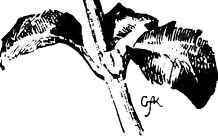
Fig. 4. Chimaphila maculata.
By far the most time devoted t o fall gardening is spent in putting the bulbs into the ground, but there are many shrubs and plants which may be set out now with advantage in our northern latitude, provided they are planted early enough to insure new roots forming before hard frost. As growth ceases in a temperature lower than 400, the thermometer is the best guide in all localities for the novice gardener to consult. No garden rules yet found would apply equally well to Maine and Virginia, or to New York state and California. A little observation and experimenting on one's own account are worth more than any printed advice, besides adding interest and zest to one's work.
A fernery out of doors forms one of the chief delights in the hardy garden - a cool, delicious, retreat in midsummer, a never-failing source of supply for bouquets and the jardiniere, and not least among its many virtues, it may be said to fairly take care of itself when once established. For beginners the autumn is the best time to collect ferns from the woods. It is then near their dormant season, yet the fronds are not so dry that the various species may not be easily distinguished. Notwithstanding a popular tradition to the contrary, ferns are easily transplanted, provided they are lifted at the proper season. When dormant, they have been brought across the Atlantic in a hand-bag with perfect success; carried in the crown of a lady's bonnet from the mountains to her home, a distance of over five hundred miles, slowly traversed; and at another time a clump of them flourished after six weeks of almost constant knocking about, packed between two old overshoes in the bottom of a Saratoga trunk.

Fig. 5. Sarcodes sanguinea.
Whichever ferns grow well about your neighborhood may be relied upon to thrive in your garden in a loose, light soil enriched with leaf mould, peeped at by the sun for a few moments daily and watered occasionally with a fine spray, if the weather be very dry. A shady and sheltered position is best chosen for the hardy fernery. The wind that snaps the fronds and parches the ground must be avoided as well as the noon-day sun. Under favorable conditions the ostrich, the sensitive and the cinnamon ferns, the common brake in several varieties, many aspidiums or shield ferns with their finally serrated plumes, the maiden-hair and the diminutive polypody may be made to thrive as vigorously in the shadow of your house as they did in their native glens. In no other part of the garden may so many souvenirs of pleasant travels be treasured up as in the fernery - not least among the reasons for its existence. The thriving fern-bed suggests the possibility of a nook in the garden where wild flowers will tangle with the delightful unconscious grace they wear in fields, woods and road-sides. How enchanting a reality, but how hopeless, you say, to think of transplanting a bit of forest to one's own door-yard! An anemone would surely never survive its first glimpse of a mowing machine, and who could reasonably expect to find arbutus trailing its sweet self over ground sold at so much a front foot!
But let the skeptical novice take up "Mary's Meadow," or "Letters from a Little Garden," remembering that Mrs. Ewing's knowledge wherefrom she wrote was, for the most part, gleaned in transforming the barren, neglected grounds about a soldier's barrack into a "Parkinson's Paradise." Let her make an excursion to the nearest woods while the first flush of enthusiasm lasts and dig up generous clumps of violets - purple, yellow and white; anemones, hepaticas, blood-root, wake-robins, wild azaleas, jacks-in-the-pulpit, arbutus, partridge-berry and wintergreen vines, golden rod, mountain laurel and rhododendron, the feathery clematis, columbines, sweet-briar, azaleas, wild honeysuckles, blue flag and whatever else tempts her, rejecting nothing because it looks wild and frail. So far from any of these plants just mentioned not doing as well in a garden as in their natural homes, they dividually known to improve under ordinary cultivation.
Even arbutus increases and blossoms abundantly year after year about the roots of a certain bed of rhododendrons, which supply it, apparently, with every needful condition.
Nearly all wild flowers require a light soil, plentifully enriched with leaf-mould, and demand, especially, that their roots be kept cool. In the dense shade of the woods, plants rarely suffer from droughts, but in gardens, the rapid evaporation of dew and rain is to be guarded against by laying small flat rocks among the roots of the flowers. Given light, air and sunshine for the leaves, and rich, cool soil for the roots to spread themselves in, and few wild plants, unless especially exacting, will miss their native nooks. Florists say many house-plants die, not because the leaves and stalks are unable to endure the hot and dry air of our living rooms, but because the pots in which they are confined, taking on the temperature about them, slowly bake the rootlets clinging to their sides. If the pots were plunged in larger pots or boxes of moist saw-dust or sand, our rubber plants and palms might imagine themselves in a tropical forest and grow accordingly.
There are, of course, many beautiful flowers which die annually that every one wants in her garden ; sweet peas, mignonette, pansies, heliotrope and nasturtiums, for example, and it is well to plan spaces for them now, though their blossoms seem so far off, because with the woods to draw from, there is danger of their being crowded out. But the nearer one comes to having a hardy garden entire, the nearer perfection it will be from the practical, artistic and poetical stand points, but not from your gardener's point of view - you must be prepared for withering blasts of scorn from that quarter. Can any one imagine a lovely painting with a geometrical flower-bed in the foreground, or think of a poet rhapsodising in a sonnet "To A Well-Sheared Coleus Star?" The hardy garden has other advantages, however, besides its permanence, its faculty of taking care of itself, its greater artistic beauty, or its wealth of mementoes of travel and friendships. "A garden of hardy flowers," writes Mrs. Ewing to her "little friend," is "pre-eminently a garden forcut-flowers. You must carefully count this among its merits, because if a constant and undimmed blaze i outside were the one virtue of a flower-garden, upholders of the bedding-out system would now and then have the advantage of us.
For my own part, I am prepared to say that I want my flowers quite as much for the house as the garden, and so, I suspect, do most women".
Mrs. R. H. Gray.
Continue to:


My Books

