


Cherry. Part 3
Description
This section is from the book "A Dictionary Of Modern Gardening", by George William Johnson, David Landreth. Also available from Amazon: The Winter Harvest Handbook: Year Round Vegetable Production Using Deep Organic Techniques and Unheated Greenhouses.
Cherry. Part 3
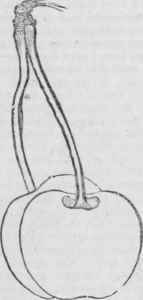
Knight's Early Black. Pom. Mag.: Thorn
(Fig. 28.) "This is, as its name imports, one of Mr. Knight's seedlings, raised in England, about 1810. It is not, externally, unlike the Black Tartarian, of which such exaggerated descriptions have been given. ripens earlier than it - at Philadelphia, about the 1st of June. The fruit is over medium size, heart shaped. Skin deep purple, when fully ripe quite black. Flesh delicate, juicy, and well flavoured. Taken altogether it may be pronounced a cherry of the first order." - Rural Reg.
Fig. 28.
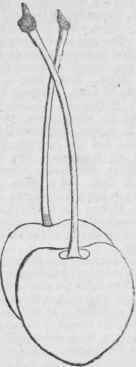
Elton. Pom. Mag.: Thomp
(Fig. 29.) "The Elton is an English cherry, raised in 1806. It is truly excellent, and must always remain a favourite, even though newer varieties contest the claim to our esteem. It is above the medium size, ripens early, shortly after the May Duke. The flesh is tender, abounding in luscious juice; skin pale yellow, with a blush on the sunny side. The tree is of strong growth, and on that account additionally entitled to our regard." - Rural Reg.
Fig. 29.
Late Duke
Pom. Mag.: Thomp. (June Duke of Coxe. Shippen Cherry.) (Fig. 30.) "This is a valuable variety, similar to its predecessor, the May Duke. It ripens considerably later than it, and has the property of hanging long on the tree. The fruit is large, rather flattened; when fully ripe, rich dark red; flesh yellow, abounding in juice, scarcely so rich as the May Duke; its habit is robust; bears abundantly. Coxe calls it the most valuable cherry of the season." - Rural Reg.
Fig. 30. - (P. 144).

Propagation
Although grafting is sometimes adopted, budding is far preferable. The stock for standards should be the wild cherry, but for dwarfs or walls the mahaleb. If the stones be sown either for stocks or to raise varieties, they are best committed to the ground in September. They will vegetate the following spring, and when one year old are fit for budding if dwarfs are required, but four years usually elapse before they attain the height of six feet, required for standards.
Walls
No fruit is more improved by a good aspect than the cherry. Allot a south wall to the best sorts, and east and west for succession. The Morello will be productive on a north wall, but on a south wall it is very superior fruit. No garden should be without one so grown.
Wall Pruning
In May or June disbud all unnecessary and foreright shoots. Train in the best-placed, lateral and terminal shoots as required. When the leaves have fallen, prune away all irregular, unproductive branches, training in their place first laterals. Never shorten a shoot unless absolutely requisite from want of space, much less prune so as to have numerous foreright spurs. All cherries bear upon very short studs with a terminal bud, on the branches from two years old and upwards. The Morello bears chiefly on the previous year's shoots, and very scantily on studs of the older branches. The Morello, therefore, requires the older laterals to be removed as often as their places can be supplied by young shoots. All studs and foreright shoots should be removed, especially from the Morello.
Continue to:


My Books

