


Frames. Part 2
Description
This section is from the book "A Dictionary Of Modern Gardening", by George William Johnson, David Landreth. Also available from Amazon: The Winter Harvest Handbook: Year Round Vegetable Production Using Deep Organic Techniques and Unheated Greenhouses.
Frames. Part 2
Raising The Frames
It is a well-known difficulty that the gardener has, in raising the frames so as to keep the foliage of the plants within them at a determined and constant distance from the glass. To remedy this, Mr. Nairn, gardener to J. Creswell, Esq., of Bat-tersea Priory, has introduced the ingenious contrivance represented in the accompanying sketch and references: - a, a movable frame; b b, inside lining of the pit; c c, outer wall. Between these the sides of the frame pass, and are lowered or elevated by racks and spindles, d d. Fig. 53.
Fig. 53.
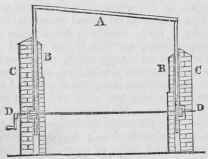
A more simple plan might perhaps be adopted, by having frames of the same length and breadth as the original, but only from an inch to three inches, or upwards, deep. These, as necessary, might be put on the top, and would be kept close by the pressure of the lights; bolts and nuts might also be easily applied, and the interstices rendered still more impervious to air by being faced with list.
The frame may often be made a substitute for the green-house; and on this subject we have the following statement of Mr. Crambe, of Redbraes, near Edinburgh: -
"Being deficient in accommodation for heaths and pelargoniums, Mr. Crambe procured two melon-frames, the dimensions of which were twenty feet long by eight wide; he then built walls of a few courses of bricks, inclosing an area of the exact size of the frames upon which they were placed. The floor was elevated six inches above the ground, level and paved with bricks laid in finely-sifted coal-ashes, having the crevices between them filled with sand, which makes a better jointing than lime, the close joints of which leave no escape for the surplus water, - placing the building in a longitudinal direction from east to west. As a fire-flue would have occupied more space than could be spared, Mr. Rogers' conical boiler was adopted. The boiler is placed on the outside and is inclosed in a case of double sheet-iron, with a movable cover, and funnel of the same material, for the conveyance of smoke into a brick-chimney, the space between the case and boiler being filled with sand as an excellent non-conductor. At right angles to the end of the pit is a brick-wall about three feet high, inclosing the boiler on two sides, leaving an open space in front for the admission of air and the clearing away of ashes.
A movable wooden cover, of a triangular form, is placed above, to protect the whole from the effects of the weather.
"The size of the boiler is eighteen inches high by twelve in diameter at the base, and is placed upon a cast-iron grating, having a furnace-door beneath for the regulation of air. The pipes, two inches and a half wide, are conducted along the front and secured to the wall with iron hooks, it being unnecessary to convey them round the back, as the apparatus is found sufficient to heat a space of double the size.
"For fuel he has uniformly found coke to maintain a constant and regular heat: indeed this sort of boiler is not suited for the consumption of coal, although, by a little alteration of the present form, it might be made to consume it as freely as coke. When the external temperature was as low as 20°, the internal heat of the pit did not vary above 3° in fourteen hours, during which time it required no attention, and the cost of the fuel did not exceed twopence in twenty-four hours. When slight storms occurred, a covering of Russia-mats was substituted in lieu of fire-heat, which is always, to a certain degree, injurious to greenhouse plants, but more particularly so to heaths, a class of plants which, when cultivated in properly constructed pits, have a decidedly more healthy appearance than those grown in greenhouses." - Gard. Chron.
Continue to:


My Books

