


Frames
Description
This section is from the book "A Dictionary Of Modern Gardening", by George William Johnson, David Landreth. Also available from Amazon: The Winter Harvest Handbook: Year Round Vegetable Production Using Deep Organic Techniques and Unheated Greenhouses.
Frames
Frames are structures employed either in forcing, or in protecting plants, and are of various sizes.
According to the good practical rules of Abercrombie: - "The one-light frame may be about four feet and a half in width from back to front, and three feet six inches the other way; fifteen or eighteen inches high in the back, and nine in front, with a glass sash or light made to fit the top completely, to slide up and down, and move away occasionally.
"The two-light frame may be seven feet long, four and a half wide, and fifteen or eighteen inches high in the back, with bars reaching from it at top to the front, serving both to strengthen the frame and help to support the lights; the two lights to be each three feet six inches wide, made to fit the top of the frame exactly.
"The three-light frames should be ten feet six inches long, four and a half wide, and from eighteen inches to two feet high in the back, and from nine to twelve or fifteen inches in front - observing that those designed principally for the culture of melons, may be rather deeper than for cucumbers, because they generally require a greater depth of mould or earth on the beds; though frames, eighteen or twenty inches in the back, and from nine to twelve in front, are often made to serve occasionally, both for cucumbers and melons; each frame to have two cross bars, ranging from the top of the back to that of the front, at three feet six inches distance, to strengthen the frame, and support the lights; and the three lights to be each three feet six inches wide; the whole together being made to fit the top of the frame exactly, every way in length and width. "Sometimes the above sort of frames are made of larger dimensions than before specified; but in respect to this it should be observed that if larger they are very inconvenient to move to different parts where they may be occasionally wanted, and require more heat to warm the internal air; and in respect to depth particularly, that if they are but just deep enough to contain a due depth of mould, and for the plants to have moderate room to grow, they will be better than if deeper, as the plants will be then always near the glasses - which is an essential consideration in early work - and the internal air will be more effectually supported in a due temperature of warmth.
For the deeper the frame, the heat of the internal air will be less in proportion, and the plants being far from the glasses will be some disadvantage in their early growth. Besides, a too deep frame, both in early and late work, is apt to draw the plants up weak; for they always naturally aspire towards the glasses, and the more space there is, the more they will run up; for which reason the London kitchen-gardeners have many of their frames not more than fourteen or fifteen inches high behind and seven in front, especially those which are intended to winter the more tender young plants, such as cauliflower and lettuce, and for raising early small' salad, herbs, radishes, etc.
"The wood work of the back, ends, and front should be of inch or inch and a quarter deal, as before observed, which should be all neatly planed even and smooth on both sides; and the joints, in framing them together, should be so close that no wet nor air can enter. The cross-bars or bearers at top, for the support of the glasses, should be about three inches broad and one thick, and neatly dove-tailed in at back and front even with both edges, that the lights may shut down close, each having a groove or channel along the middle to conduct off" all wet falling between the lights. At the end of each frame, at top, should be a thin slip of board, four inches broad, up to the outside of the lights, being necessary to guard against cutting winds rushing in at that part immediately upon the plants, when the lights are occasionally tilted behind for the necessary admission of fresh air, etc.
"With respect to the lights, the wood-work of the frame should be inch and a half thick and two and a half broad; and the bars, for the immediate support of the glass-work, should be about an inch broad, and not more than inch and a half thick: for if too broad and thick, they would intercept the rays of the sun, so should be only just sufficient to support the lights and be ranged from the back part to the front, eight or nine inches asunder.
"All the wood-work, both of the frames and lights, should be painted to preserve them from decay. A lead colour will be the most eligible; and if done three times over, outside and in, will preserve the wood exceedingly from the injuries of weather, and from the moisture of the earth and dung".
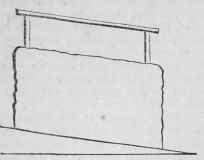
Mr. Knight has suggested an important improvement in the form of frames. He observes, that the general practice is to make the surface of the bed perfectly horizontal, and to give an inclination to the glass. That side of the frame which is to stand towards the north is made nearly as deep again as its opposite; so that if the mould is placed of an equal depth (as it ought to be) over the whole bed, the plants are too far from the glass at one end of the frame and too near at the other. To remove this inconvenience, he points out the mode of forming the bed on an inclined plane; and the frame formed with sides of equal depth, and so put together as to continue perpendicular when on the bed, as represented in the accompanying sketch, Fig. 52.
There are several minor points in the construction of frames that deserve attention. The strips of lead or wood that sustain the panes of glass should run across the frame, and not lengthwise; they then neither obstruct so much the entrance of light nor the passing off" of rain. The inside of the frame should be painted white, since plants generally suffer in them for want of light: if the accumulation of heat was required, the colour should be black.
Fig. 52.
Continue to:


My Books

