


Grape-Vine
Description
This section is from the book "A Dictionary Of Modern Gardening", by George William Johnson, David Landreth. Also available from Amazon: The Winter Harvest Handbook: Year Round Vegetable Production Using Deep Organic Techniques and Unheated Greenhouses.
Grape-Vine
Grape-Vine (Vitis vinifera). Of this fruit ninety-nine varieties are cultivated in the Chiswick Garden.
Open-Wall Culture
Varieties best suited for this, according to the experience of Mr. Hoare, are: -
Black Hamburgh. Black Prince. Esperione. Black Muscadine. Miller's Burgundy. Claret Grape. Black Frontignan. Grizzly Frontignan. White Frontignan. White Muscadine. Malmsey Muscadine. White Sweetwater.
Eighty-six of the varieties have been cultivated at Wilbeck within the last seven years, but only about fourteen found of superior excellence, and many of the others were mere synonymes. Mr. Tillery, from this long course of experience and observation, recommends the following selections: -
For The Earliest House
The Purple Constantia, or Frontignan; White Frontignan; Black Prince; Dutch, or Stillward's Sweetwater; Black Hamburgh; and Tripoli.
For Stove
White Muscat of Alexandria; Purple Constantia; White Frontignan; Grizzly Frontignan; Black Muscat; and Black Damascus.
For Green-House
Black Hamburgh; Tripoli; Grove-end Sweetwater; and Muscadine.
For Latest House
West's St. Peter's, and Charlesworth's Tokay.
For A Single House With Fourteen Rafters
One Purple Constantia; one White Frontignan; one Royal Muscadine, or Chasselas D'Arboyce; three Muscats; three Black Hamburghs, or Tripolis; three West's St. Peter's; and two Black Princes.
For Pot-Culture, To Cover In During April And May
Purple Constantia and White Frontignan." - United Gar. Jour.
Until recently but few houses for the exclusive growth of grapes under glass, had been erected in the United States. The success which attended the effort in the vicinity of Philadelphia, Boston, and other cities, has excited emulation, and at this day (1S47) one of the most attractive features of our Horticultural exhibitions, are grapes grown under glass, not exclusively through the agency of fire-heat, but in many instances by the aid of the glass alone.
Propagation
Layering is the most certain and most expeditious mode of propagating the grape-vine. In the first part of March cut away the fourth bud of the shoot to be layered, pass the shoot through the hole in the bottom of garden-pot, fill this with light rich earth, so that the wound of that fourth bud is in the centre of the earth, and two buds above its surface; fix the pot firmly to the wall, so as not to be disturbed; keep the earth constantly moist with liquid manure, giving a little every day, and a little moss tied over the surface and round the sides of the pot to check evaporation. Cut away the layer from the parent in the last week of August; and, turning it out from the pot, without at all disturbing the earth, plant it where it is to remain, and water it plentifully with liquid manure until the leaves begin to fall.
Cuttings
At the time of autumn-pruning select some middle-sized, well-ripened shoots, cut off lengths of six buds, keep them in moist sand through the winter, and, at the end of March, cut them in half, remove the two lower buds, and plant them under a wall having an eastern aspect, leaving the upper bud just above the surface, and covering them with a hand-glass. The soil must be light, rich, and well pulverized, pressed close round the cuttings, and kept constantly moist with liquid manure until the leaves fail in autumn. The surface round them should be stirred at least twice a week to allow the air unimpeded entrance.
Coiling is only a peculiar mode of propagating by cuttings suggested by Mr. Mearns, whose practice has been epitomised thus by Dr. Lindley: -
"In the propagation of vines by coiling, Mr. Mearns' practice, if single rods are contemplated, is not to leave them longer than four or five feet, and to remove all the buds but the uppermost. These rootless cuttings are coiled into long narrow pots, being so placed that the bud of the apes of the shoot, although the highest part, is still two inches beneath the surface of the soil; at the same time sufficient room is left beneath the coil for the roots to extend themselves. These cuttings being put in between the middle of January and the end of March, are plunged at once into a hot-bed between 90° and 100°, where they remain until they require more pot-room. They are then shifted, and placed in a suitable situation until again excited in November or December. When the cutting begins to grow, the shoot is trained upright, until it is seven or eight or ten joints long, when the top is pinched off. After this stopping the laterals are displaced as they appear; and if the vines have done well, two or three of the buds will also be excited at the same time, in which case the shoots are cut down to the lowest excited eye. The single shoot is then trained upright and divested of all laterals and tendrils.
None of the plants are allowed to grow longer than from four to six feet, at which length the tops are pinched off, the uppermost lateral, which is also stopped at the first joint, being left to carry off the remaining sap.
"At this season the plants are removed to a warm and sheltered situation in the open air; and when the leaves fall they are headed down to one, two, or three joints, according to their strength, and are placed against a northern aspect. When cold weather sets in they are taken back to a sheltered spot, and plunged in the ground to protect the roots, the pots being mulched over, and the rods covered to protect them from frost.
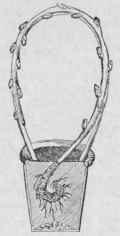
"When these yearling potted vines are brought early into action, it is recommended to bow a piece of wire above the pot with both its ends running down the inside, of sufficient height to allow the whole length of the stem to be attached to it, as represented in the accompanying figure.
"The buds from the stem being thus bent, break more regularly; and when this is effected the vine is united, and secured to an upright stake or sloping trellis. To prevent evaporation the stem is wrapped loosely in moss, which is kept constantly moist until the grapes are set, when it is removed. The plants, up to this period, are encouraged by bottom-heat and shifting; and the quantity of fruit is regulated by the size of the pot and the quality of the vine." - Gard. Chron.
Fig. 71.
Continue to:


My Books

