


Hot-Bed. Part 3
Description
This section is from the book "A Dictionary Of Modern Gardening", by George William Johnson, David Landreth. Also available from Amazon: The Winter Harvest Handbook: Year Round Vegetable Production Using Deep Organic Techniques and Unheated Greenhouses.
Hot-Bed. Part 3
When the crops are removed, and the heat declines, if well stirred, and a load or two of fresh bark mixed with it, the bed will acquire and continue in heat for an equal further lapse of time: this may be repeated throughout the year as often as the heat is found to decline. But it is necessary every autumn, entirely or nearly so, to reconstruct the bed with fresh bark; for when the old is far advanced towards putrefaction, it will no longer generate heat.
The leaves of the oak and sweet chestnut, and doubtless of many other trees, answer for hot-beds as well or even better than tanner's bark, since they will continue to afford a moderate heat for nearly twelve months without any addition or stirring. They are to be collected as they fall in autumn, and carried to some situation, or be so hurdled in, that they may be preserved from scattering by the winds; the heap should be six or seven feet thick, trod firmly down, and moderately watered if dry. In a few days, a very powerful heat is produced, and in five or six weeks will have become so regular, that it may be broken up and the beds constructed with its materials, water being again employed if dryness appears, and they must be well trod down as before. There are many other substances that generate heat during fermentation; there is perhaps no vegetable substance that does not; even a heap of dry sticks acquires a strong accession of temperature if moistened. Mr. Burnet recommends the trial of the refuse matter thrown off in dressing flax, for constructing hot-beds: this refuse he says he has observed, when left undisturbed, continue at a temperature of 64° for many months, he seems to intimate as long as fourteen. This material is, however, to be had in very few districts.
Grass and other green herbage, and even wetted straw mixed with coal-ashes, have been used on an emergency with success. Instead of forming hot-beds with open sides, as has been hitherto described, pits of brickwork and other materials, are very generally constructed for containing the fermenting mass. It may be laid down as a fundamental principle, that in applying heat, it should always be brought to the bottom of the body to be heated.
Mr. Flanagan only allows the heat of fermenting dung to be employed, the steam being prevented entering the frame. One advantage arising from this he states to be, that fresh made dung may be employed, and consequently the loss sustained by any preparation is prevented. If, however, it be a fact that the steam of dung is rather beneficial than otherwise, fresh fermenting dung can be used without any detriment that I am aware of in other pits of which we have plans. Mr. P. describes his pit as follows: - "It is four feet deep within, the lowest ten inches of solid brickwork sunk in the earth; the remainder is a flue three inches wide in the clear, carried entirely round the pit, the inner wall of which, forming the sides of the pit, is four inch work, well bedded in mortar, and pointed to prevent the steam penetrating; the outer wall of the flue is also four inch, but open work to admit the steam, and that of dung coatings into the flue, the top of which is rendered tight by a covering of tiles, etc. The frame rests on the external wall of the flue. The cavity of the pit, which is kept dry by means of drains, is nine feet two inches long, two feet eight inches wide, and four feet deep.
It is filled with broken bricks to within eighteen inches of the top, then a foot of short cold dung, six inches of very rotten dung trod down so as to admit half an inch depth of coal-ashes, for preventing the intrusion of any worms that may be in the dung, completes the structure".
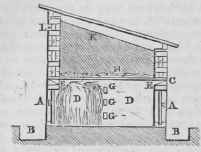
The accompanying sketch and references will fully explain the plan of Mr. West. D D, chamber in which the dung is placed, three and a half feet deep, surrounded by nine inch brick work. One half of this is tilled longitudinally with dung at the commencement, which, if kept close shut up, will last twelve or eighteen days, according to the quality of the dung. As the heat declines, the other side is filled, and the temperature is further sustained by additions to the top of both as the mass settles. When this united heat becomes insufficient, the side first filled being cleared, the old manure must be mixed with some fresh, and replaced, this being repeated alternately to either heap as often as necessary. A A, are the doors, two of which are on each side for the admission of the dung. They are two and a half feet square, fitted into grooves at the bottom, and fastened by means of a pin and staple at the top. B B, are small areas sunk in front, surrounoed by a curb of wood; G G G, are bars passing longitudinally as a guide and support in packing the dung; C, represents a bar of cast-iron, two inches wide and three quarters of an inch thick, placed on the edge of which there is a row, a foot asunder across the chamber to support a layer of small wood branches and leaves, H, for the pupose of sustaining the soil, K, in the upper chamber; E E, represents the orifices of which there are a series all round the pit, communicating with the flue F F F, which surrounds the beds: the exterior wall of this flue is built with bricks laid flat, the inner one of bricks set on edge.
The flue is two inches wide, and for the sake of strength, bricks are passed occasionally from side to side as ties. The top of the flue, and the internal part of the wall, which rises at the back and front to the level the earth is meant to stand, are covered with tiles, over the joints of which slips of slate bedded in mortar are laid to prevent the escape of the steam of the dung; I, represents one of two plugs, which stop holes left to regulate the heat and steam as may be necessary. The outer wall supports the lights. For the convenience of fixing the dung, it is best to fill the half of the chamber at the commencement, before the branches, mould, etc, are put in.
Fig. 86.
Hot-water is a much more manageable source of heat for a hot-bed than fermenting vegetable matter, and for plans see the title Hot-Water.
Continue to:


My Books

