


Pear. Part 7
Description
This section is from the book "A Dictionary Of Modern Gardening", by George William Johnson, David Landreth. Also available from Amazon: The Winter Harvest Handbook: Year Round Vegetable Production Using Deep Organic Techniques and Unheated Greenhouses.
Pear. Part 7
Culture Of Wall Trees
The following are the best directions that have been given on this subject: - "Plant the trees against the wall, fifteen feet from each other. If they have three shoots properly placed, they may all be retained. If only one strong healthy shoot, in the spring the first tree is to be headed down within nine inches high, the next to that one foot nine inches, and so on alternately, till you get to the other end of the wall.
"In the summer, train three shoots from the three uppermost eyes of each tree, rubbing off" all the rest. Nail in one to the right, one to the left, and the other perpendicularly. The two side branches should not be trained in a horizontal position till the second year. In the following winter, the centre shoot of each is to be cut off two feet above the first pair of lateral branches.
"In the next summer, the three top buds are to be trained one on each side, perfectly horizontal, and the middle one upright; should the centre this season grow vigorously, and advance two feet before the end of June, top it at that height with the thumb and finger. Three shoots may probably start from the three upper eyes; if so, nail them in an easy position, and bring them to their proper places in the winter pruning; but most probably only two will break. In this case, as soon as they are six inches long, train them both on the opposite side from which you wish a third shoot, and rather lower than the horizontal line; this will cause the next bud below the two shoots already obtained to start. As soon as this advances a few inches, restore the shoots from the top bud to an erect position, and the other about half the way between the horizontal and perpendicular line; observing, if one of the side shoots gets the advantage of the other, to depress the strong or elevate the weak as occasion may require; by which means both will be kept of an equal length.
Fig. 124.
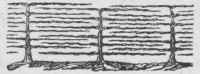
"If by the autumn the centre shoot has not advanced two feet, or if it does not appear to have ripened, cut the three summer shoots off within half an inch of the place from whence they sprang; there will then be an upright centre two feet above the second pair of horizontal branches, which will not fail to push vigorously the next spring, and although in this case only one pair of branches will be produced this season, the tree will be much benefited from having the upright shoot topped, as the sap by this check will be forced into the horizontal branches below, which are often starved by the prodigious and in a great measure useless growth of the centre. All superfluous shoots are to be pinched off within an inch or two as they appear, and, as far as may be, without leaving the branch absolutely bare, and entirely cut out in the winter pruning.
"This treatment is to be repeated till those trees which have their first pair of horizontal branches within nineinches of the ground, arrive within two feet or eighteen inches of the top of the wall. These trees are to be considered permanent; those which have no branch till they are one foot nine inches high, are for a temporary purpose only, and they may have a pair of branches within four inches of the top of the wall.
"In ten years, we will suppose, on a twelve feet wall, most of the branches will reach twelve or thirteen feet from the stem. The wall, therefore, presents somewhat the appearance of the follow- ing figure.
Fig. 126.
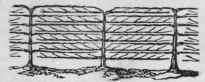
"Hitherto it is obvious, that as we have doubled the number of trees, and each tree has produced as many, or perhaps more branches than are capable of bearing fruit, and those owing to stopping the leader longer than usual; so we must up to this time have double, or more than double, the usual quantity of fruit.
"After the temporary trees are removed, the crops will be still larger. Riders would not have answered the same purpose, as they would have already interfered for the last two or three years with the principals, that is, on a wall not exceeding twelve feet; and on this plan the temporary trees are to be trained three or four years longer,during which time they may be expected to produce considerable crops. The extremities of the horizontal branch being now within a foot or two of the stem of the next tree, the management of the permanent trees is to be altered. Instead of pinching off all shoots as they appear, at every fifteen or eighteen inches all along the horizontal branches, retain a well-placed shoot in an easy slanting position upwards, towards the branches of the temporary trees. Next year continue to train them in the same direction; and, in order to give them more room, elevate the branches of the temporary trees six inches above the place they have hitherto occupied.
"The third year the shoots will most likely show blossom; the free bearing sorts will do so in two years; but it must be recollected, we are speaking exclusively of the shy bearers. If plenty of blossom appears, the temporary trees may now be taken up and planted in, otherwise they may remain another year. After the temporary trees are removed, the young shoots, which we will suppose are now fully furnished with blossom buds, may be trained in a direction sufficiently sloping upwards for the terminal bud of each to be within four or five inches of the horizontal branch above.
"If they show a disposition to grow too strong, they may be deeply notched, or a ring may be made round such as require it, about the eighth of an inch wide. In either case, let it be close to the branch from which the shoots spring. As they become diseased or worn out, or have produced long spurs, train in a young shoot by the side of any it may be proper to displace, and after the second year cut the old one out. In case a tree, after it has filled the space allowed, continues very luxuriant in growth, recourse may be had to the usual methods of checking it, either by cutting the roots or sawing the stem half or two-thirds through, just below the surface of the ground, or deep notches may be made on each side with the chisel. A single tree may of course be treated according to this plan.
"The temporary trees, if taken up with care, will certainly grow, and be found very valuable; they may be either planted against another wall, or if of sufficiently hardy kinds, treated as espaliers, cutting off the two or three upper pairs of branches; in either case, young shoots are to be trained in between the old ones, as already directed for the permanent trees. Should you have a wall with an aspect not sufficiently good to ripen the fruit of these removed trees, or should they be of those kinds which will not come to perfection as espaliers, they will nevertheless still be valuable in this case. After they have been removed a twelvemonth, treat them according to Mr. Knight's mode of changing the sort; that is, leave the horizontals at very nearly the full length, but cut off all the spurs, leaving only bare poles at every twelve, fifteen, or eighteen inches, according to the growth of the sort you intend to introduce.
Fig. 127.
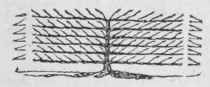
"On the upper side, all along the branches, make a notch a little deeper than the bark; it may be done by two cuts with a sharp knife, the side nearest the trunk being perpendicular, the other sloping; the graft may then be introduced by the common mode of crown-grafting. Train the shoots from the grafts as before directed. In two years and a half most kinds will produce an abundant crop, and the trees will be very nearly as large as those on the wall from whence they were taken; thus having an advantage over young trees of at least ten years." - Gard. Mag.
In pruning pear trees, never cut off a shoot which can be laid to the wall; for by cutting oft* the foreright shoots you produce a succession of the same without a chance of producing fruit. By laying in these shoots, less wood is produced; and those buds either on the old wood, or any short spurs which otherwise would have produced only wood shoots, bear a succession of blossom. - Gard. Chron.
Impregnating The Blossom Of Wall Trees
Mr. Harrison truly observes, that " it is very usual to see healthy pear trees produce an abundance of bloom, but set a very small proportion of fruit: this is particularly the case with the tenderest kinds. The reason is in some cases from the stamina being destitute of farina; and in others, from the farina having been dispersed before the pistils had arrived at a proper state for its reception. To remedy this, as soon as the first blossoms have expanded, and the pistillum is in a proper state of maturity, impregnate six upon each corymb of blossom. The florets to choose for this operation are those situated nearest the origin of the spur; for when pears set naturally, it is very generally such florets. The time for this operation is calm, dry days, and, if possible, when the sun is not very hot upon the trees. Immediately afterwards give each tree about eighteen gallons of manure water, or soft pond water, at the roots. The trees should never be washed over the tops for a considerable time after this impregnation has been effected." - Treat, on Fruit Trees.
Continue to:


My Books

