


Rexdle's Tank System
Description
This section is from the book "A Dictionary Of Modern Gardening", by George William Johnson, David Landreth. Also available from Amazon: The Winter Harvest Handbook: Year Round Vegetable Production Using Deep Organic Techniques and Unheated Greenhouses.
Rexdle's Tank System
First suggested, I believe, by Mr. Rendle, nurseryman, of Plymouth. I have given, in the customary monthly calendars, the necessary intimations when the bark-beds will probably require stirring, but those troublesome, uncertain, and dangerous operations, dangerous to the plants, are entirely rendered needless by Mr. Rendle's plan. It has been adopted by some of the best practical gardeners with entire satisfaction.
A tank of iron or wood, twenty feet long, five feet broad, and six inches deep, is constructed in the centre of the house, and surrounded by a walk, except at the end, where the boiler is fixed for heating it. The top of the tank is covered with large slabs of 6late, cemented together, to prevent the excessive escape of steam. Around this is a frame sufficiently high to retain the bark, in which the pots are plunged. The boiler and tank are filled with water, and this circulates, when the fire is lighted under the former, by means of two pipes, one from the top of the boiler, and the other returning nearer to its bottom. The expense of piping, and danger of their freezing, is avoided; the fire only requires to be kept lighted for two hours at night, and again for the same period in the morning; the water, when once heated, retaining its temperature for a long time. In a small house, the apparatus can be con structed for 51., and in all, for less than half the cost of hot-water pipes. The saving in tan and labour is also very great; in some places tan is expensive, and where it is cheaper, the trouble and litter incident to its employment, and the dangers of loss from fungi and insects, of which it is the peculiarly fertile foster-parent, render it objectionable as a source of heat.
And whenever the tan has to be renewed, the trouble and destruction of plants is always great.
"In my new propagating house," says Mr. Rendle, "the tank or cistern is placed in the centre, with a walk surrounding it, so as to enable the propagator with greater ease to attend to the plants, etc.
"On the outside of the house is a fire-shed, in which the boiler is fixed. The tank, made of wood, one and a half or two inches thick, which I find the cheapest material, (it also prevents the water cooling so fast as it does either in stone or iron,) may be lined with lead or zinc. Exactly in the centre of the tank is a partition, serving the double purpose of causing the water to circulate, (as well as to support the edges of the slates,) an aperture being left in the partition, of about two inches in breadth, to allow the water a free passage. The flow-pipe enters near the appendage of the tank, at the mouth of which pipe a piece of perforated copper is placed, as also at the return-pipe, to prevent dirt and sediment from finding its way into the boiler. After everything is properly fixed, the tank is filled with water, which, of course at the same time fills the boiler.....
The tank is about four inches deep. Across it, and resting on its sides, are placed slate stones about an inch and a half thick, cut square at the edges. These are fastened to each other by Roman cement, or Aberthaw lime, to prevent a superfluity of steam from escaping into the house......Around the edges of the slates a piece of inch board, about nine inches deep, should be placed to enclose the sawdust, sand, moss, or other plunging material".
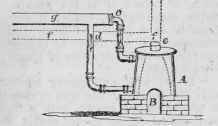
In the following sketch, for which, as well as for the next, I am indebted to Mr. Rendle, A is a transverse section of Rogers's conical boiler; B is the fireplace ; g, the tank : c, the flow-pipe; d, the pipe by which the water returns to the boiler; e, is the hole for the smoke, which, joined to a flue,/, can be made either to ascend the chimney at once, or to pass round the house.
Fig. 145.
The next sketch is a Pinery, fitted up with Mr. Rendle's tank.
Fig. 146.
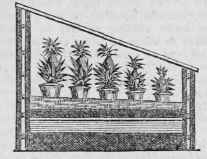
It is described as "a very useful and most desirable structure for the growth of the Pine Apple, with a hollow wall, recommended by all garden architects in preference to a solid wall - the heat or cold being not so readily conducted as through a solid mass of masonry. " Mr. Rendle might have added, that hollow walls are also much drier. - Rendle's Treatise on the Tank System. See Stove, etc.
Continue to:


My Books

