


Shading
Description
This section is from the book "A Dictionary Of Modern Gardening", by George William Johnson, David Landreth. Also available from Amazon: The Winter Harvest Handbook: Year Round Vegetable Production Using Deep Organic Techniques and Unheated Greenhouses.
Shading
Shading deserves more attention than it usually obtains, for there is not a plant when in blossom that is not prolonged in beauty and vigour by being shaded from the midday sun. Nor should shading be attended to merely with regard to blooming plants; for they are benefited by it during all periods of their growth. Every plant transpires at a rate great in proportion to the elevation of the temperature; the greater the transpiration the more abundant is the absorption of moisture; and the moment the roots fail in affording a supply equivalent to the transpiration, the leaves flag, or become exhausted of moisture, and if this be repeated often, decay altogether. - Shades, properly managed, prevent this injurious exhaustion. Those used at Sion House deserve particular attention, not only because they are applicable to hot-houses, pits, and hot-beds of every description, but because they may be rendered available in the covering of fruit walls, to exclude the frost from the blossom, and the birds or flies from ripe fruit; and also in the covering of flower beds, hay ricks, harvested corn, temporary structures for public assemblages, etc.
Fig. 155.
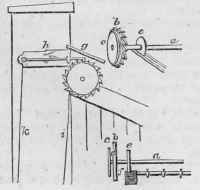
"The length of these rolls at Sion House is between fifty and sixty feet, but we have no doubt they might be made longer, since this depends on the diameter of the pole or rod, a, and the toughness of the timber employed, or its power to resist torsion. On one end of this rod, and not on both, as is usual, a ratchet wheel, b, is fixed, with a plate against it, c, so as to form a pulley groove between, d, to which a cord is fastened, and about three inches further on the rod is fixed a third iron wheel, about six inches in diameter, and half an inch thick, e. This last wheel runs in an iron groove, /, which extends along the end rafter or end wall of the roof to be covered.
"The canvas or netting being sewed together of a sufficient size to cover the roof, one side of it is nailed to a slip of wood placed against the back wall, that is, along the upper ends of the sashes; the other side is nailed to the rod, a. When the canvas is rolled up, it is held in its place under a coping, g, by a ratchet, h, and when it is let down, the cord, i, of the roll is loosened with one hand, and the ratchet cord, k, pulled with the other, when the canvas unrolls with its own weight. The process of pulling it up again needs not be described. The most valuable part of the plan is, that the roll of canvas, throughout its whole length, winds up and lets down without a single wrinkle, notwithstanding the pulley-wheel is only on one side. This is owing to the weight of the rod, and its equal diameter throughout. By this plan a house 100 or 150 feet long, might be covered with two rolls, the two pulleys working at the two ends; but if it were thought necessary, the two rods might be joined in the middle, and by a little contrivance, the pulley and groove placed there, so as to work both of the rolls at once from the inside of the house, from the back shed, or from the front." - Gard. Mag.
Continue to:


My Books

