


Stoves. Part 2
Description
This section is from the book "A Dictionary Of Modern Gardening", by George William Johnson, David Landreth. Also available from Amazon: The Winter Harvest Handbook: Year Round Vegetable Production Using Deep Organic Techniques and Unheated Greenhouses.
Stoves. Part 2
Roof
The framework of this may be of iron or of wood, and the comparative merits of the two materials are thus fairly stated by Dr. Lindley: - "The advantages of iron roofs for hot-houses are, that they are more durable than wood, and allow a far greater quantity of light to pass through them than wooden roofs, the difference being as seven to twenty-eight, or even thirty, in favor of iron, and this is a most important property, when we consider that the healthy action of plants is in proportion to the quantity of light which reaches them. The disadvantages of such roofs are, that they rapidly heat, and as quickly cool down; they are therefore liable to sudden changes of temperature, which can only be guarded against by great attention, which is expensive, and by a large consumption of fuel. We should say use iron, if you prefer success and beautiful form to cost, and can rely upon the attention of your people, but employ wood if you are obliged to study economy." - Gard. Chron.
Fig. 158.
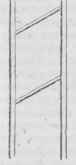
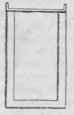
Fig. 159.
Heating
Flues for imparting heat to hot-houses are for the most part superseded by either tanks or hot-water pipes; but where retained, the top should be formed of iron plates, these admitting the heat most readily into the house, and consequently requiring a less consumption of fuel. If it be desirable to have covering for the flues that will retain the heat longer, as when the fires are made up at night, this may be readily accomplished by putting a row of the thick square pav-ing tiles on the top of the whole length of the flue, an hour or two before the houses are finally closed.
The power of retaining heat, or in other words of cooling slowly and gradually, which renders the covering of paving tiles desirable, renders the tank system of heating by hot-water still more efficient. It is a scientific operation throughout, and will be best appreciated by a reference to Mr. Rendle's diagram and description at page 500.
It is a law of fluids that their hottest portions rise to the surface of the containing vessel, and the coldest portions as invariably subside to the lowest surface, because heat makes them expand, and consequently diminishes their specific gravity; and the abstraction of heat makes them contract, and as consequently increase that gravity. When the boiler and tank are filled with water, as well as their connecting pipes, and a fire is lighted, the hottest portions rise to the top, flow along the surface, and getting cool, sink to its bottom, and passing downward enter again at the lower part, to be once more heated and pass through the same circulatory system. A very small boiler will speedily raise the heat of the water, in a very large tank, to 180°; and if this heat be imparted late in the evening, it will retain its heat but little diminished until the morning. The smoke, by means of a flue, may be made to impart heat to the house, by passing through it, or may at once enter the chimney or pipe attached to the summit of the boiler.
Hot water in a tank is superior to the same source of heat in pipes, because it is not liable to freeze; and it is preferable to steam, because its heating power continues until the whole mass of water is cooled down to the temperature of the house, whereas steam ceases to be generated as a source of heat the moment the temperature falls below 212°. If steam be employed, Mr. Tredgold has given the following rules for calculating the surface of pipe, the size of the boiler, the quantity of fuel, and the quantity of ventilation, required for a house thirty feet long, twelve feet wide, with the glass roof eight feet, length of the rafters fourteen feet, height of the back wall fifteen feet. The surface of glass in this house will be seven hundred and twenty feet superficial, viz., five hundred and forty feet in the front and roof, and one hundred and eighty feet in the ends. Now, half the vertical height, seven feet six inches, multiplied by the length in feet, and added to one and a half time the area of glass in feet, is equal to the cubic feet of air to be warmed in each minute when there are no double doors.
That is, 7.5 X 30+11/2 X 720=1305 cubic feet. But in a house with wooden bars and rafters, about one-tenth of this space will be occupied with woodwork, which is so slow a conductor of heat, that it will not suffer a sensible quantity to escape, therefore 130 feet may be deducted, leaving the quantity to be warmed per minute = 1175 cubic feet.
To ascertain the surface of pipe required to warm any given quantity of air, multiply the cubic feet of air to be heated per minute, by the difference between the temperature the house is to be kept at, and that of the external air in degrees of Fahrenheit's thermometer, and divide the product by 2.1, the difference between 200, which is the temperature of the steam pipes, and the temperature of the house: the quotient will be the surface of cast iron pipe required.
Now in the house, the dimensions of which are above given, if the lowest temperature in the night be fixed at 50°, and 10° are allowed for winds, and the external air is supposed to be at zero or 0 of Fahrenheit, then 1175 multiplied by 60°, and the product divided by 2.1, the difference between 200 and GO, will give us the quotient 236 = to the surface of pipe required. Now the house being thirty feet long, five pipes of that length, and five inches in diameter, will be about the proper quantity.
If hot water be employed instead of steam, the following proportions and information, obtained from Mr. Rendle, may be adopted confidently as guides. In a span roof propagating house, forty feet long, thirteen feet broad, seven feet high in the centre, and four feet high at the two fronts, having a superficial surface of glass amounting to 538 square feet, Mr. Rendle has a tank eighty-three feet long, running round three sides of the house, four feet wide and about eight inches deep, and consequently capable of containing nearly 300 cubic feet of hot water, though only half that quantity is used. This is closely approaching to the size pointed out, according to Mr. Tredgold's formula. The mean temperature of a hot-water tank, will never be much above 100°, so that for the sized house mentioned by that skillful engineer, the divisor must be 2.1 times the difference between 100° and 60°, which gives as the quotient 335 cubic feet.
The tank in Mr. Rendle's propagating house, is built lined with Roman cement, and if the temperature at the time of lighting the fire be 90°, the temperature of the atmosphere of the house 67°, and the temperature out of doors 50°, the quantity of small coal or breeze required to raise the temperature of the water to 125°, is 28 pounds. In twelve hours, the water cools after the fire has been extinguished, from 125° to 93°.
When steam is employed, the space for steam in the boiler is easily found by multiplying the length of the pipe in feet, by the quantity of steam in a foot in length of the pipe.
Interior diameter of pipe in inches. | Decimal parts of a cubic foot of steam in each foot of pipe. |
1 ... | . 0.0545 |
1 1/2 | . 0.1225 |
2 . . | . . 0.21S5 |
21/8 . . | . . 0.34 |
3 . . | . . 0.49 |
4 . . | . . 0.S73 |
5 . . | . . 1.063 |
6 . . | . . 1.964 |
7 . . | . . 2.67 |
8 . . | . . 3.49 |
9 . . | . . 4.42 |
10 . . | . . 5.45 |
In the above noticed house, the length of pipe five inches in diameter, is 150 feet; and these multiplied by 1.363=20.5 cubic feet of steam, and as the pipe will condense the steam of about one cubic foot and one-third of water per hour, therefore the boiler should be capable of evaporating l1/2 cubic feet of water per hour, to allow for unavoidable loss. In the extreme case of the thermometer being at zero, the consumption of coals to keep up this evaporation will be 12 pounds per hour.
These calculations are all founded upon the supposition that the condensed water is returned to the boiler whilst hot; but if this cannot be effected, then one-twelfth more fuel will be required. The boiler for the supply either of steam or hot-water, should be covered with the best available non-conductor of heat, and this is either charcoal or sand.
A case of brickwork, with pulverized charcoal, between this and the boiler, is to be preferred to any other. A boiler having a surface of seventy feet exposed to the air, in a temperature of 32°, requires an extra bushel of coals to be consumed per day, to compensate for the heat radiated and conducted from that surface; and the smaller the boiler, the greater is the proportionate waste. The surface of the pipes should be painted black, because a surface of this colour gives out more heat in a given time than any other. - Prin. of Gardening.
Continue to:


My Books

