


Protection For Wall Fruit-Trees
Description
This section is from the book "The Gardener V2", by William Thomson. Also available from Amazon: The New Organic Grower: A Master's Manual of Tools and Techniques for the Home and Market Gardener.
Protection For Wall Fruit-Trees
Fig. 1 represents a 12-foot wall, the canvas drawn a little way up. a a a a are 3/8-inch wrought-iron rods, which are hooked into an eye in an iron bar projecting from the wall at the top, and fixed at the bottom by means of a screw-nail through its flattened end in a 3-inch-square post, b b is a narrow piece of 1-inch deal attached by iron staples to the rods, so that it easily moves up or down. To this rail, at c c inside the canvas, are attached the ends of the ropes, which pass over four pulleys, by which means the rail is quite easily drawn to the top, and with it the canvas - both drawn up together like a curtain, being strung upon the rods by rings about 18 inches apart. When drawn up, the cords are twisted round hooks on the side of one of the posts (d) to keep it in its place at the top, and prevent the ropes getting soiled. When let down, a loop thrown over each end of the bottom rail secures the canvas from flapping with the wind. The sheet of canvas represented in the fig. is 20 feet long by 9 feet wide. It was found that 20 feet was as long as could be conveniently worked.
After binding the whole piece round with cotton tape, four pieces of the same, with rings attached, are laid across, and stitched to the canvas, so as to run exactly with the rods a a a a in fig. 1. Fig. 2 is intended to show how the tape is run through the rings, the rings being arranged at equal distances one from the other. The two outside pulleys are simply screwed upon the tops of the boards in front of the coping, with holes for the ropes to pass down inside; but the two centre ones are on a separate piece of plank, and project slightly beyond the other board, it being necessary to have the ropes outside. At the point where two pieces of canvas meet, instead of the usual post for each rod, one post 6 inches broad is put in, and the rods are placed so that there may be room for the ends of the rails to pass each other when working them (fig. 3). Here I have given you, in as few words as possible, the mode of protection tried here for the first time last spring. I cannot, however, place it before your readers without acknowledging that it is not faultless.
It will be readily perceived by some that the canvas, thus drawn up in a bundle of loose folds at the top, will shade at least 18 inches of the top of the wall, and that its folds will be apt to be dashed against the branches by the wind, and be in danger of knocking off the buds. I think it would be an improvement, when some shade from bright sunshine is necessary, if the board at the top were removed, to cause a circulation of air between the canvas and the wall. I have sketched fig. 4 to show how these evils may be remedied. Instead of the canvas falling from the top, according to the plan, its proper resting-place should be at the bottom. Instead of nailing the canvas to the front of the coping-board, it may be nailed to a similar rail as b b, fig. 1, and the ropes attached to it instead of to the lower one. By having the canvas at bottom, it is removed farther from the wall; and owing to the direction of the sun's rays, very little of the bottom of the wall will be shaded, and, besides, the folds of the canvas will still be at liberty to play with the breeze, to dry it when let down wet (one of its great advantages). To set the board at liberty, I think it would not be a very difficult matter to have the pulleys supported on projecting iron plates (fig. 5), with good strong supports under them.
The boards might be set on hinges at the front of the coping, and worked up and down by a small pulley fixed into the stone coping, with a hole for the rope to pass down close by the wall. I have tried to show at fig. 5 that the pulleys now in use are closed in over the top, so that the ropes cannot get out of their place if left hanging loose. I have no hesitation in saying that frigi domo is the best material for this purpose.
R. I. G. P.
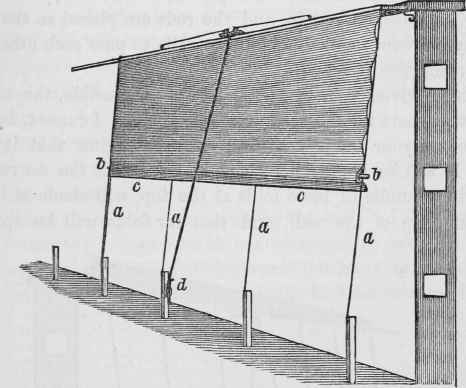
Fig. 1.

Fig. 2.
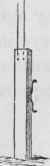
Fig. 3.
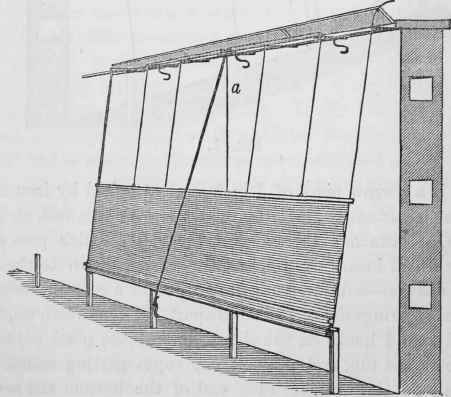
Fig. 4.
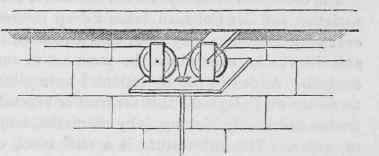
Fig. 5.
Continue to:


My Books

